 Email: support@vespaagogo.com

Scooter Life
Saigon Street Life: A Visual Journey Through Transport in the 1990s
2026-02-10
Stand at the corner of Nguyen Hue and Le Loi today. It is a wall of sound: honking SUVs, shiny scooters, and the looming shadow of skyscrapers like Bitexco. It is electric, chaotic, and undeniably modern.
Now, hit mute.
Erase the Grab taxis. Swap the roar of engines for the soft whir of bicycle chains. Replace the glass towers with yellow-washed French colonial shophouses. Instead of exhaust fumes, imagine the air thick with the scent of charcoal fires and rain.
Welcome to Saigon in the 1990s.
For locals, it is a memory of innocence. For travelers, it is a glimpse into a lost world - where the pace was slower, and the streets belonged to people, not machines.
Let’s travel back to the era of transport in the 1990s.
1990s Saigon: The Historical Backdrop
The early 90s marked a pivotal moment for Vietnam. The country was just waking up from the "Subsidy Period" (Bao Cap) - a time of rationing and scarcity - and stepping tentatively into "Doi Moi" (Renovation). The US embargo was lifted in 1994, and normalization of relations followed in 1995.
Visually, the city was in a "twilight zone" between the old world and the new. During this transition, the streets of Saigon were not yet dominated by motorbikes. The economy was opening up, but cars were still a luxury reserved for diplomats or the very few wealthy elite.
The visual landscape was defined by simplicity and horizontal lines; there were no high-rises to block the tropical sky. The traffic wasn't a fight for survival; it was a flowing river of manual labor and mechanical endurance. It was a time when you could cross the street without an adrenaline spike, simply by making eye contact with a cyclist.
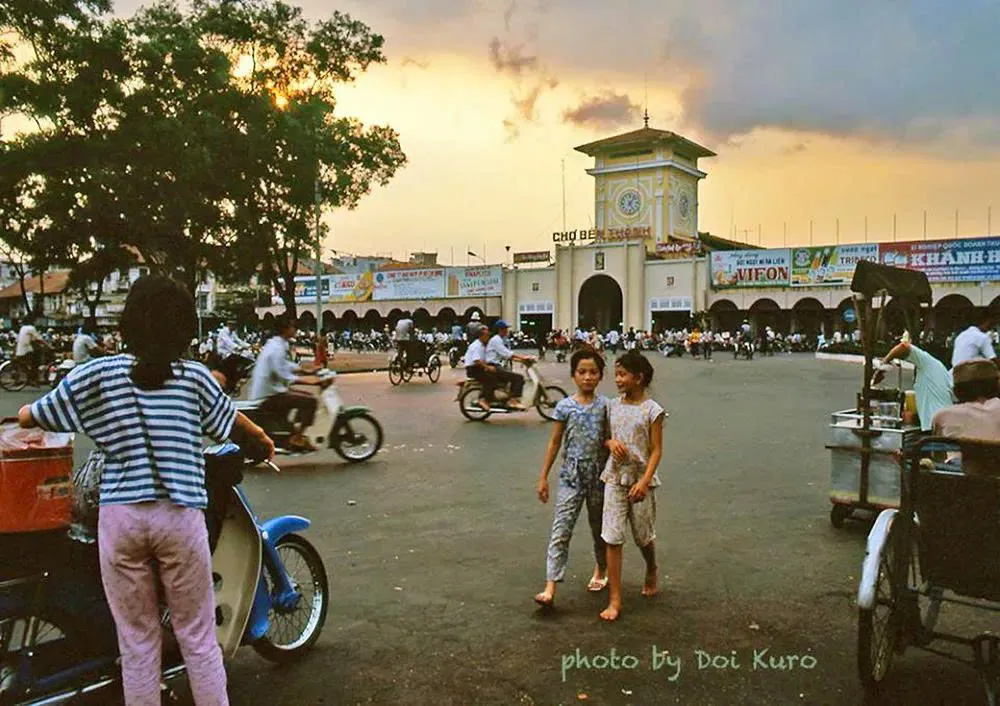
Transportation at Ben Thanh Market in the 1990s
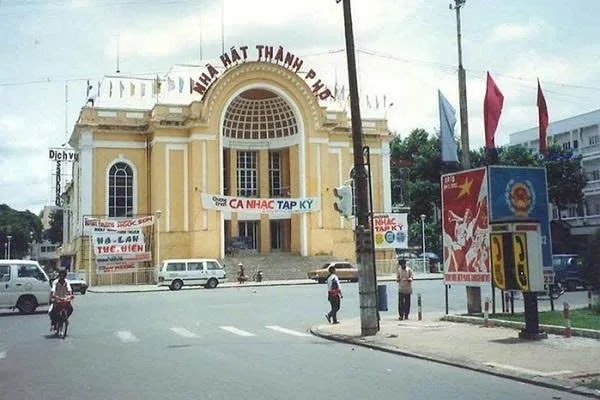
Streets at the city theater
Icons of the Road: Vehicles that Defined an Era
To understand the spirit of Saigon back then, you have to look at what people drove - or more accurately, what they pedaled.
The Bicycle: The Silent River
Before the motorbike became king, the bicycle was the emperor. In the early 90s, rush hour didn't sound like a roaring engine; it sounded like the metallic ring-ring of thousands of bicycle bells and the soft whir of rubber on asphalt.
It wasn't just about transport; it was about survival and elegance intertwined. You would see students in white Ao Dai (traditional dress) cycling to school, the white silk panels fluttering dangerously close to the spokes, yet never catching. You would see office workers in crisp shirts sweating in the humid sun, and merchants hauling impossible loads - stacks of crates, live pigs, or family-sized furniture - balanced precariously on a reinforced rear rack.
Brands like "Thong Nhat" (Reunification) or old French Peugeots were prized possessions. The bicycle was the heartbeat of the city - steady, reliable, and powered by human grit.
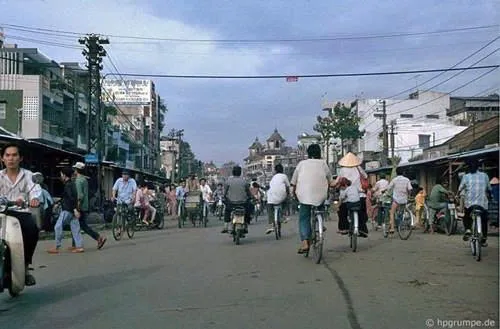
The streets in the 90s were bustling with bicycles
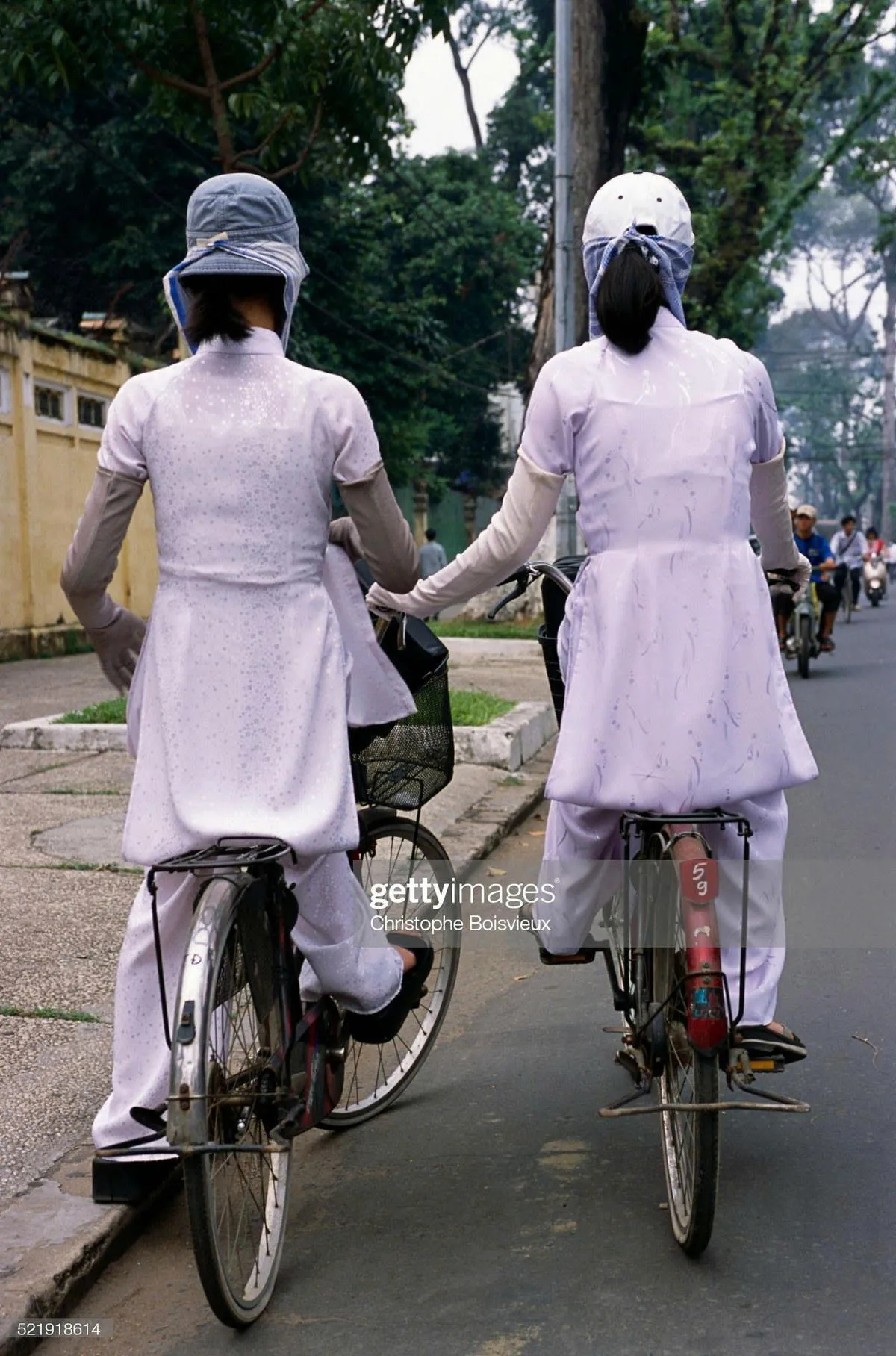
Two pretty girls ride bikes to school.
The Cyclo: A Slower Pace of Life
Today, the Cyclo is largely a tourist novelty restricted to certain zones. But in the 1990s, it was the primary taxi service. It was the Uber of its day, but with more soul.
You would see Cyclos everywhere - parked under tamarind trees for a midday nap, the drivers' hats pulled over their eyes. They were the city's observers. Sitting in a cyclo meant you were the king of the road; you sat in front, with nothing blocking your view, while the driver pedaled behind.
It represented a slower, unhurried lifestyle. Families of four would squeeze onto one seat for a Sunday outing. Hiring a cyclo involved a ritual of haggling, a smile, and a slow cruise through the boulevards - a luxury of time that is harder to find in modern Ho Chi Minh City.
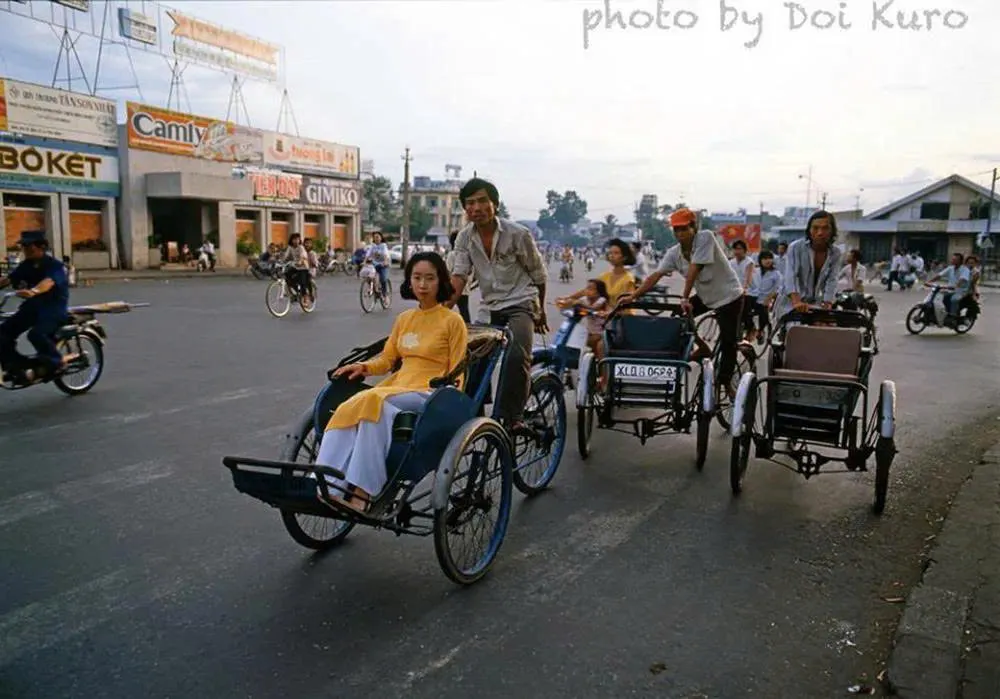
A cyclo carrying a girl at Ben Thanh Market in the old days
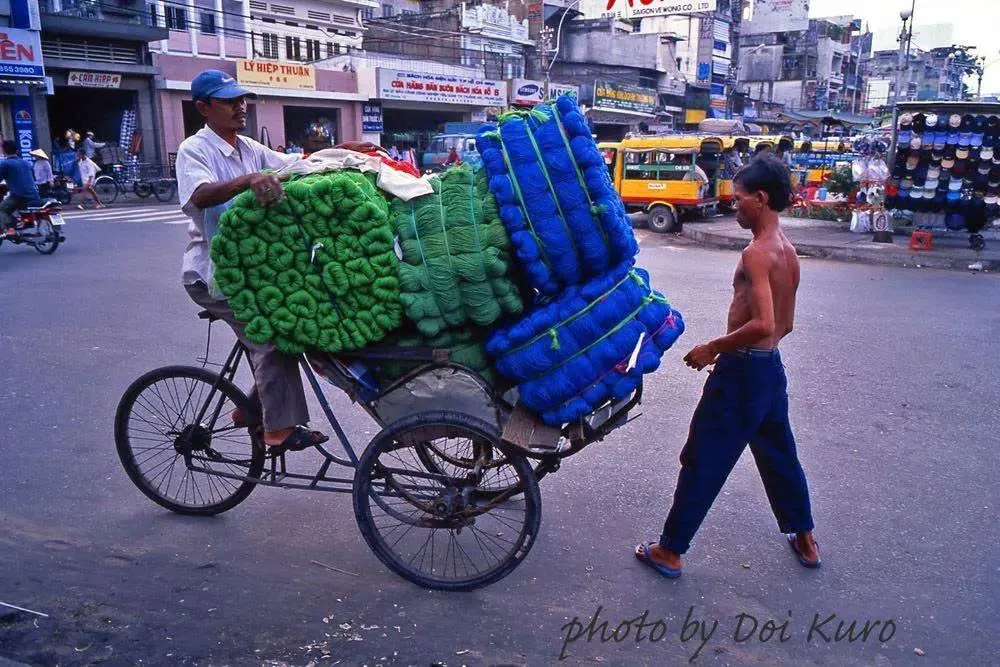
Cargo rickshaws in Cho Lon Market
The Rise of Motorbikes: Honda Cub & Vintage Vespas
As the economy improved mid-decade, the soundscape of the city began to change. Engines began to replace pedals.
The Honda Cub (specifically the Cub 78, 81, or the "Dame") was the ultimate dream. It was durable, fuel-efficient, and possessing one meant you had "made it." It was the workhorse of the family, often carrying parents and two children sandwiched in between.
And then, there were the Vespas.
Even back then, Saigon had a love affair with Italian design, a lingering influence from decades prior. While the Honda Cub was pragmatic, the vintage Vespa (Standard, Super, or Sprint models) was a style statement. They were often older, inherited bikes, kept alive by mechanics who were nothing short of magicians. Seeing a 2-stroke Vespa buzzing through the quiet streets in the 90s, leaving a faint trail of blue smoke and that distinctive pop-pop-pop sound, is an image that connects directly to the soul of the city.
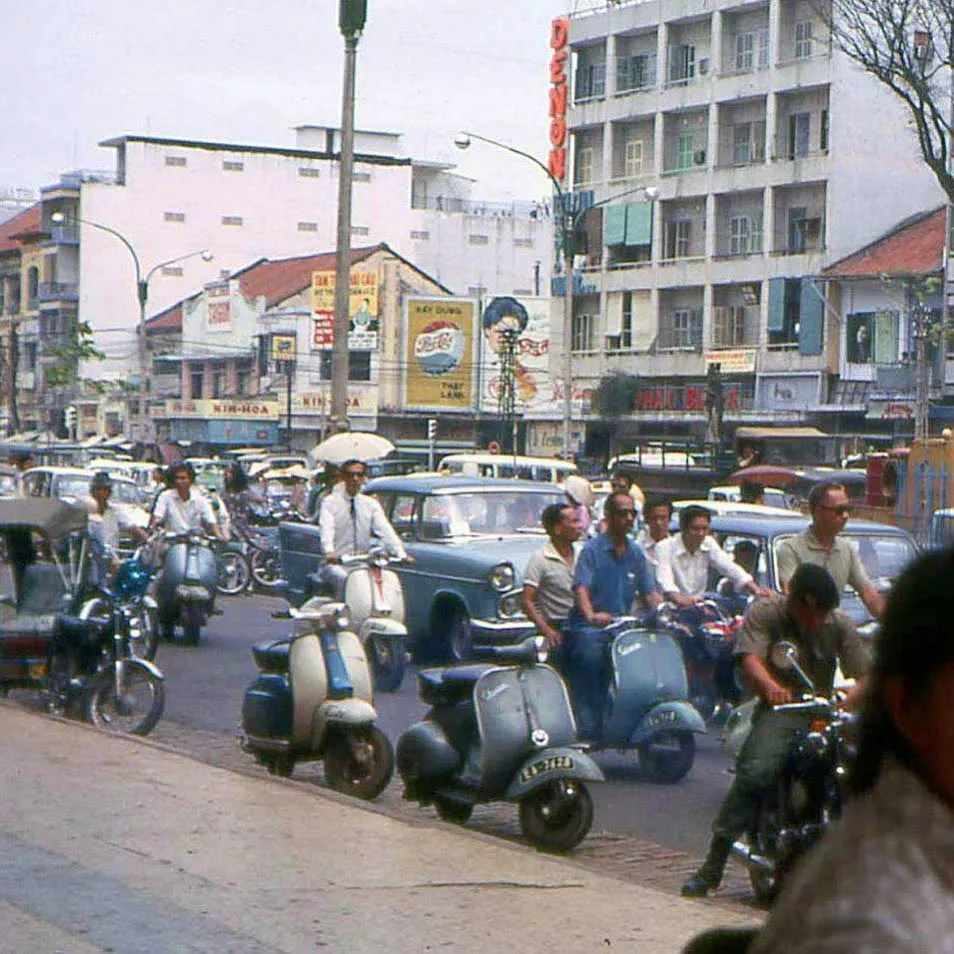
Vespa scooters - a fashionable style at the time.
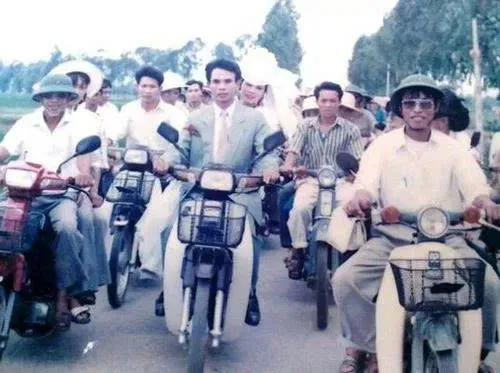
The Dream motorcycle is also popular among people.
Public Transport: The Legend of "Bus 1990" and the "Lambro"
For those who couldn't cycle or afford a Cub, there was public transport. But forget the air-conditioned green buses of today.
Searching for images of a bus 1990 in Saigon reveals a gritty reality. These were often repurposed trucks or aging vehicles from the Soviet era (like the Karosa) or old Desoto buses with wooden frames. They were painted in faded yellows and reds, windows wide open to catch the breeze because AC was non-existent. They were famously overcrowded, with the "lơ xe" (bus assistant) leaning out the door, shouting destinations and pulling passengers in while the bus was still moving.
And we cannot forget the Lambro (Lambretta three-wheelers). These small, noisy, three-wheeled mini-buses were the shuttles of the working class. They rattled, they shook, and they squeezed 10 people into a space meant for 6. They were banned in later years due to traffic safety, making photos of them a rare and precious glimpse into the 90s era.
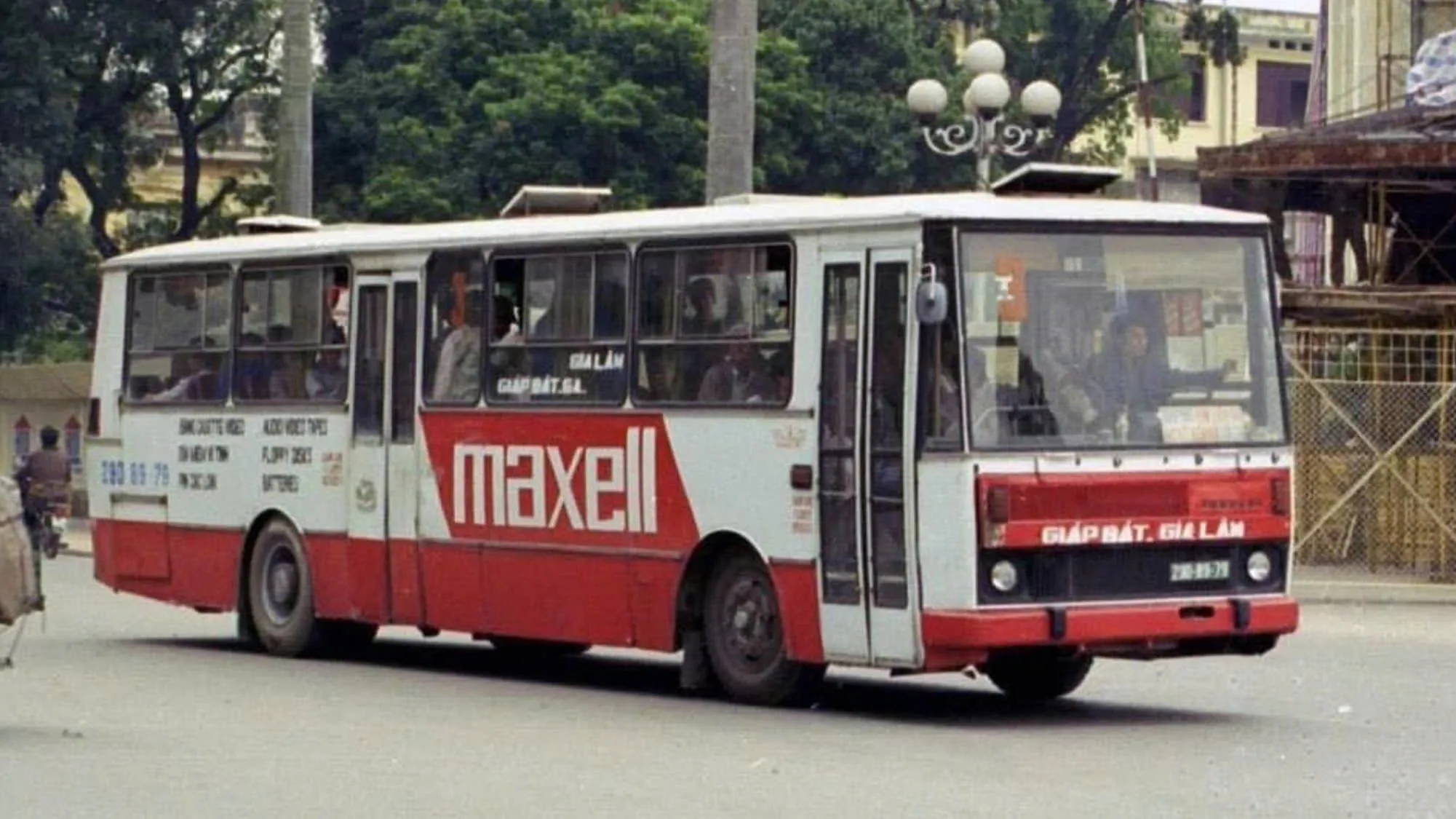
Karosa Car
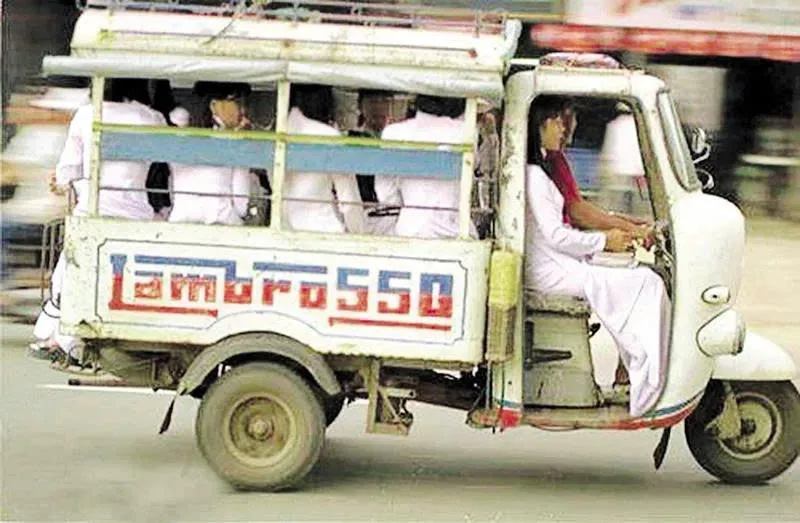
Lambro 550
The Street Atmosphere: Chaos & Charm
What makes the transport in the 1990s so visually arresting is not just the vehicles, but the atmosphere surrounding them.
The streets were a shared living room. Sidewalks were dotted with "bơm vá xe" (tire pump and repair) stations - usually just a man with a hand pump, a bucket of water, and a few rubber patches, ready to fix the frequent bicycle flats.
Street vendors with carrying poles (gánh hàng rong) walked fearlessly in the middle of the road, selling sticky rice or tofu pudding, weaving between bicycles and cyclos. There were no traffic cameras, few traffic lights, and absolutely no lane discipline. Yet, there was an organic flow - a silent agreement between drivers that kept everything moving. It was a raw, unfiltered version of the organized chaos that expats find so fascinating today.
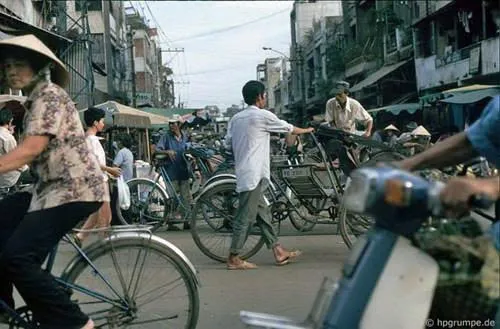
The chaotic streets of Saigon in the 1990s
Conclusion
Saigon has grown up. The skyline is taller, the cars are faster, and a new Metro line is about to change the city's rhythm once again. The "Silent River" of bicycles has been replaced by a dynamic current of commerce and modernity.
However, the images of transport in the 1990s serve as a reminder of the city's resilience and charm. It was a time when the journey was just as important as the destination.
While we cannot turn back the clock, we can still capture the feeling.
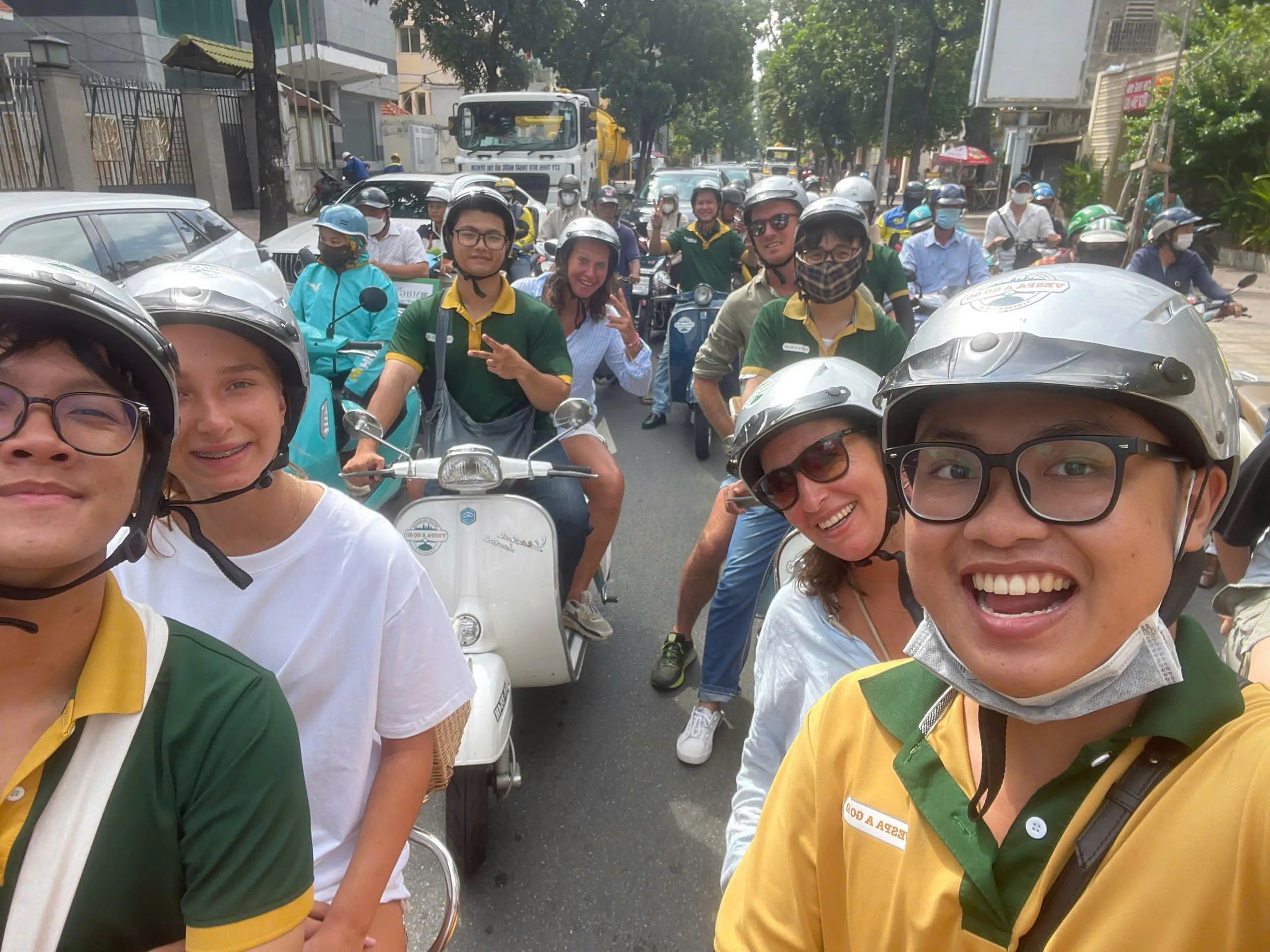
If you crave that authentic connection to the past amidst the hustle of the present, the spirit of the 90s is still alive. At Vespa A Go Go, we specialize in bridging these two worlds. Hop on the back of our vintage Vespas - the very icons of that golden era - and let us take you through the hidden alleys and vibrant streets.
It is the perfect way to experience the modern energy of Ho Chi Minh City while riding on a piece of history. Come ride with us, and feel the timeless rhythm of Saigon.
Other tips
- Vietnam Scooter & Motorbike Culture: Learning to Ride the Flow (Safely) for the First Time
- Saigon Street Life: A Visual Journey Through Transport in the 1990s
- Traffic in Ho Chi Minh City: A Survival Guide to Saigon Traffic (2025)
- Vintage Vespa: How to Ride, Weight & 2-Stroke Basics
- The History of the Vespa in Vietnam: A Cultural Icon on Two Wheels
- Saigon Motorbike Tour: An Authentic Way to Experience Saigon
