 Email: support@vespaagogo.com

Vietnam Travel
Vietnamese Lunar New Year (Tết) 2026
2026-02-12
The Vietnamese lunar new year, known in Vietnam as Tết Nguyên Đán, or simply Tết, is the country’s most important holiday. It is the cultural axis around which the entire year turns. If you are in Vietnam during this period, you are not witnessing a festival layered on top of daily life. You are watching daily life itself temporarily dissolve, reorganize, and restart.
For travelers and expats, this can be deeply moving or deeply confusing, depending on expectations. Streets empty. Businesses close. Transportation patterns reverse. Yet behind those disruptions lies one of the clearest windows into how Vietnamese society actually works: how it understands family, obligation, memory, renewal, and time.
This guide is written to explain the Vietnamese lunar new year, specifically in 2026. Not as a checklist of customs, but as part of daily life. You’ll learn why Tết matters, how long it really lasts, how Vietnamese people prepare, what traditions still shape behavior today, how the experience differs across regions, what travelers should realistically expect, and how to experience the atmosphere of Saigon before Tet in a way that feels authentic rather than staged.
What Is the Vietnamese Lunar New Year, and Why Does It Matter More Than Any Other Holiday
The Vietnamese lunar new year marks the beginning of the new year according to a lunisolar calendar that has been used in Vietnam for centuries. While the calendar shares roots with those used in China and parts of East Asia, Tết has evolved into a distinctly Vietnamese cultural event with its own rituals, social rules, and emotional weight.
In practical terms, Tết is the point at which Vietnamese people close the old year and reset their moral, familial, and spiritual balance. This is not metaphorical. It shapes behavior. Conflicts are set aside. Apologies are made. Debts are repaid if possible. Houses are cleaned thoroughly to remove lingering bad fortune. New clothing symbolizes renewal. Certain words, topics, and actions are avoided during the first days to prevent attracting misfortune.
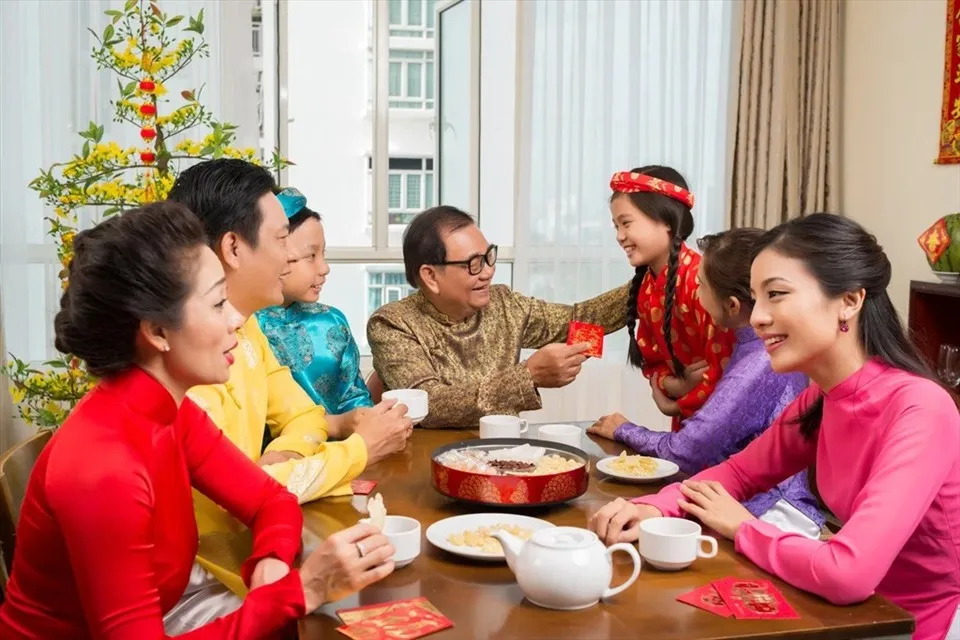
Unlike Western New Year celebrations, which often emphasize public celebration and personal resolution, the Vietnamese lunar new year is family-centered. The most important moments happen inside homes, not in public squares. The most meaningful rituals are quiet, repetitive, and often invisible to outsiders.
For Vietnamese people, missing Tết is not a casual choice. Millions of migrant workers, students, and overseas Vietnamese make significant sacrifices to return home. Cities like Ho Chi Minh City and Hanoi are partially empty because people are not traveling for leisure. They are returning to their place in the family structure.
How the Vietnamese Lunar Calendar Works (And Why Tết Changes Every Year)
To understand the Vietnamese lunar new year, it helps to understand why its date shifts each year and why this matters culturally.
Vietnam uses a lunisolar calendar, meaning months are based on the moon’s cycles, while the year is adjusted to stay aligned with the solar year. Each lunar month begins on a new moon and lasts either 29 or 30 days. Twelve lunar months add up to roughly 354 days, which is shorter than the solar year. To correct this difference, an extra leap month is inserted every two to three years.
Tết marks the first new moon of the first lunar month. This is why it can fall anywhere between late January and mid-February. The shifting date is not an inconvenience in Vietnamese culture, it reinforces the idea that time is cyclical and adaptive, not fixed.
While others may find this calendar abstract, For Vietnamese people, it governs agricultural rhythms, religious observances, ancestor anniversaries, and wedding dates. Even in modern urban life, people still consult the lunar calendar for important decisions, especially during the Vietnamese lunar new year period.
For travelers, this explains why Tet planning must always be year-specific. Assumptions based on Western calendars do not apply.
When Is the Vietnamese Lunar New Year in 2026, and How Long Does It Really Last?
In 2026, the first day of the Vietnamese lunar new year falls on February 17. This date is determined by the lunar calendar and shifts each year, usually landing between late January and mid-February.
However, Tết is not a single day or even a long weekend. It functions in three overlapping phases, each with different implications for travelers.
1. The Pre-Tết Period (About 7 - 14 Days Before New Year’s Eve)
This is the most dynamic and visible phase of the Vietnamese lunar new year. Markets fill with flowers, fruits, and ceremonial foods. Homes are cleaned deeply. Families shop for gifts, offerings, and new clothes. Transportation becomes increasingly busy as people begin returning to their hometowns.
From a traveler’s perspective, this is when Vietnam is loud, crowded, and visually colorful. Flower markets operate late into the night. Streets are packed. Prices may rise slightly due to demand and extra pay for the staff, especially for flights, buses, . This is the best time to visit Vietnam and immerse yourself in the unique Tet atmosphere with the locals.
2. The Core Tết Days (New Year’s Eve + First 3 Days)
These are the spiritual and familial core of the Vietnamese lunar new year. Most businesses close completely. Restaurants operate on limited schedules or not at all. Families stay home and spend time with each other. Visits follow social rules and hierarchy.
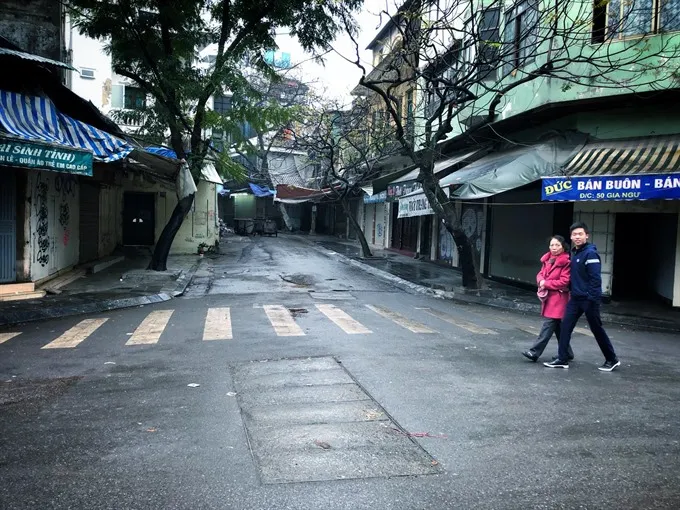
Big cities become unusually quiet. Traffic in those cities drops sharply. Public spaces feel empty. This is not the end of the world, it is just the state of Tết in Vietnam.
3. The Post-Tết Period (Up to 5 Days After)
After the third day, life gradually resumes. Businesses reopen. The streets are open with people starting to travel. Pagodas remain busy with people praying for good fortune in the new year.
For travelers, understanding these phases is essential. While the city is resuming to its normal state, traveling during this time is NOT recommended since a lot of locals will start traveling with their families and loved ones after the 3 main days of Tet. There will be a surge in accommodations and transportation prices. You might want to wait past this period to travel again if you’re on a budget and want to avoid the crowd.
How Vietnamese People Prepare for the Vietnamese Lunar New Year
Preparation for the Vietnamese lunar new year is extensive, deliberate, and often physically exhausting. It is not treated as optional or casual. Preparation is considered part of the ritual itself.
Cleaning the Home: Removing the Old Year
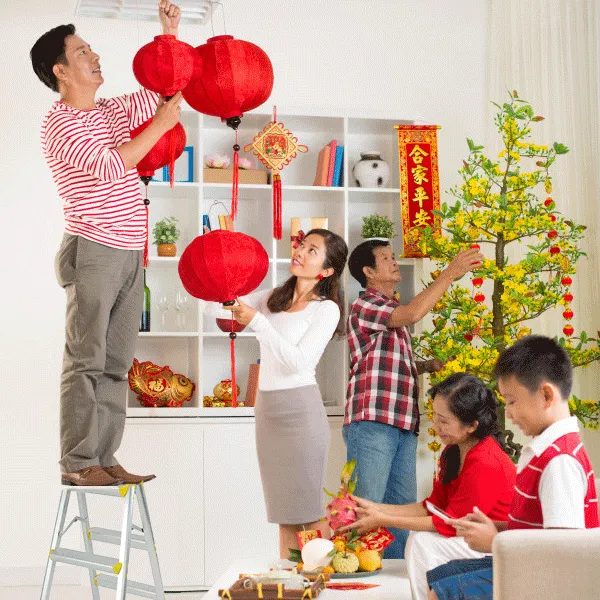
Before Tết arrives, homes are cleaned from top to bottom. This includes areas that may be ignored during the rest of the year: storage spaces, altars, ceilings, and door frames.
The logic is symbolic. Dust, broken items, and clutter are believed to accumulate negative energy or bad luck from the previous year. Cleaning removes these influences so the new year can begin “clean.”
Once the new year begins, sweeping or throwing away trash is traditionally avoided for at least the first day, as it is believed to sweep away incoming luck.
Shopping for Tết: Abundance Over Luxury
Shopping before the Vietnamese lunar new year focuses on symbolic abundance, not indulgence. Families purchase:
- New clothes, symbolizing renewal and looking good for a new start.
- Fruit and flowers for altars, as offerings for the ancestors and decoration.
- Ingredients for traditional foods that are prepared in advance.
- Small gifts and snacks for relatives and visitors.
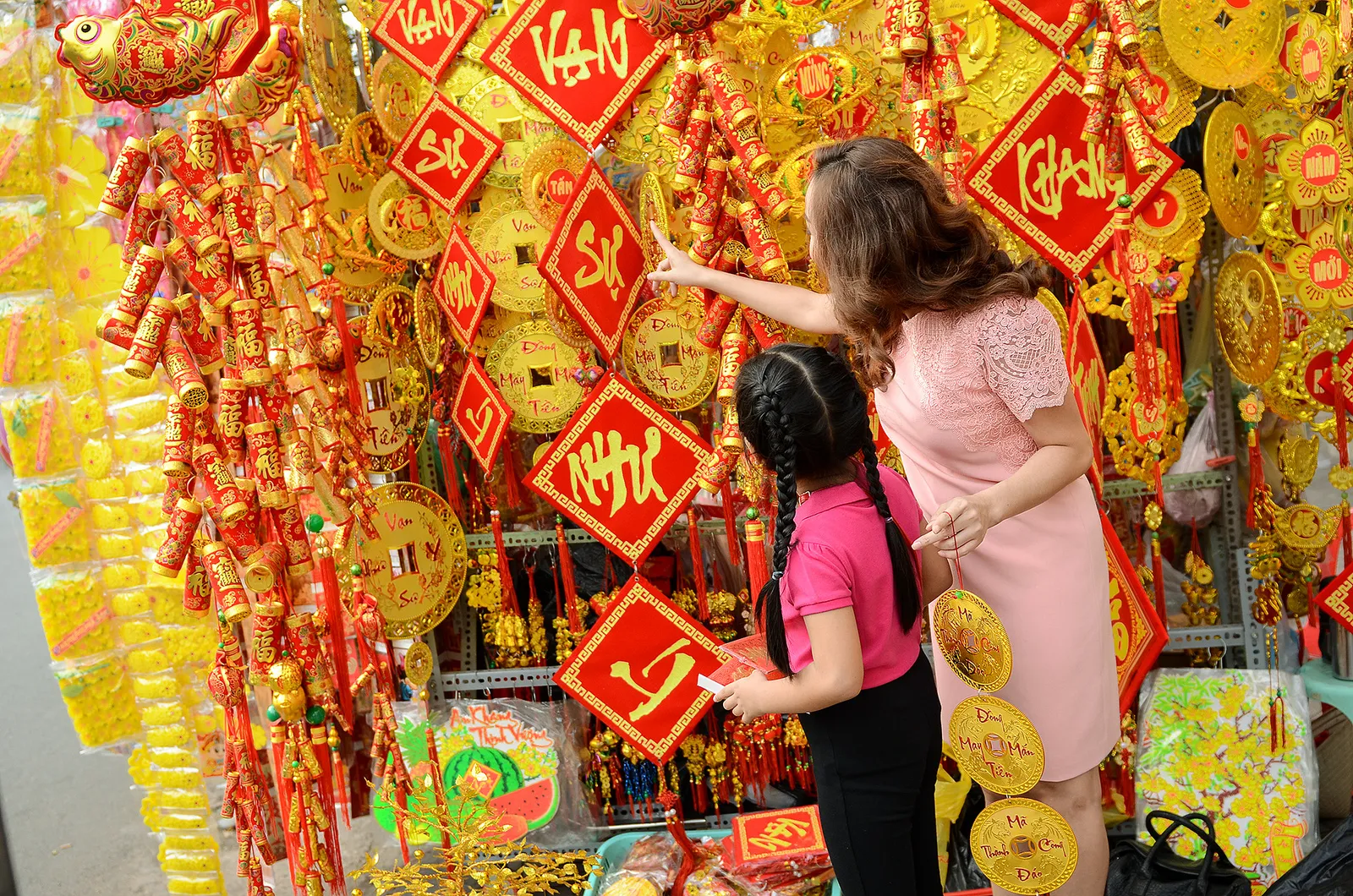
Markets become crowded and chaotic. Flower streets appear in major cities. Prices may increase slightly, especially close to New Year’s Eve.
Preparing the Ancestral Altar
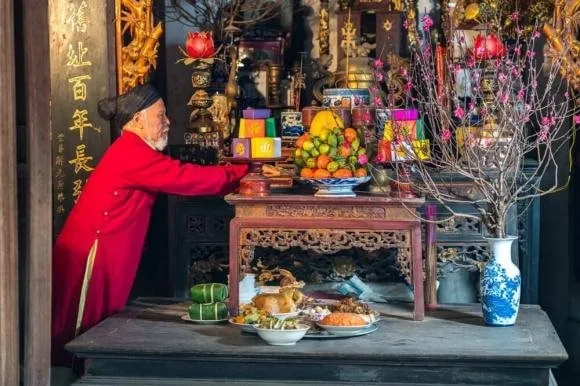
For many families, the ancestral altar is the emotional center of Tết. Offerings are refreshed and carefully prepared. Incense holders are cleaned. Photographs are arranged carefully.
The altar is decorative and well-cleaned. It is understood as a place where ancestors are invited to return home during the Vietnamese lunar new year. Meals are offered symbolically before the living family eats.
General Vietnamese Lunar New Year Traditions and Rituals Explained
Ancestor Worship During Tết
Ancestor worship is central to the Vietnamese lunar new year. Families believe that ancestors return home during this period and must be welcomed respectfully.
Incense is burned daily. Offerings of food, fruit, tea and other edible things are placed on the altar. This practice fosters continuity between generations and emphasizes gratitude over nostalgia.
Xông Đất: The First Visitor of the Year
The first person to enter a home after midnight on New Year’s Eve is believed to influence the household’s fortune for the year. This ritual, known as xông đất, reflects the belief that personal energy affects collective luck.
Some families invite a trusted person in advance. Others ensure that a suitable family member is the first to step outside and return after midnight.
Lì Xì: Red Envelopes and Symbolic Giving
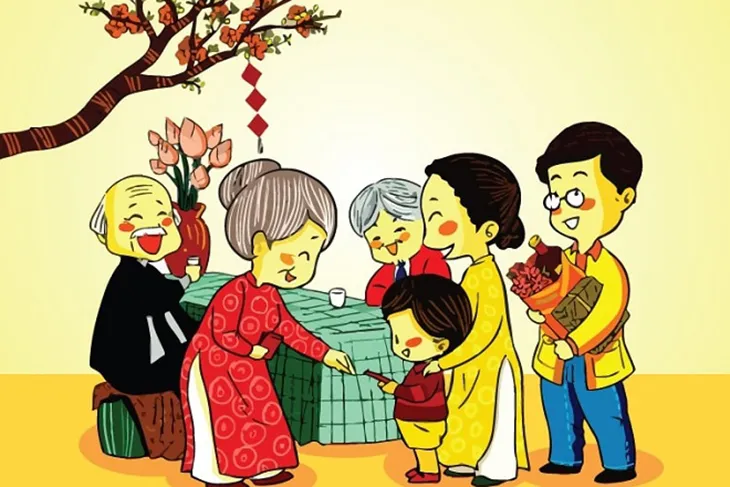
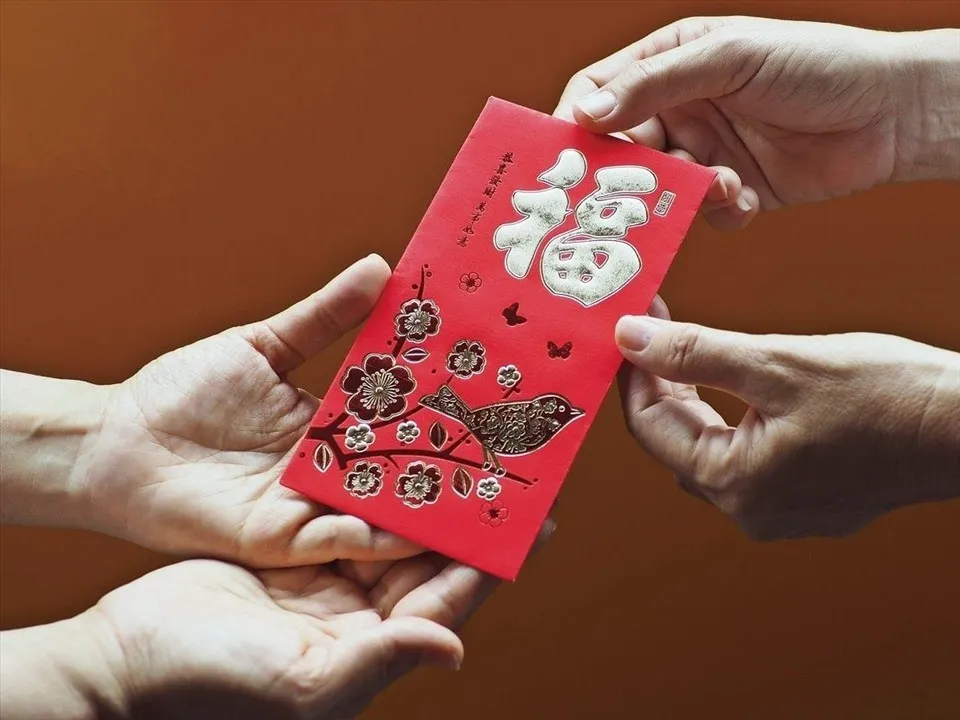
Red envelopes containing money, called lì xì, are given to children and elders. The amount is less important than the symbolism. New bills are preferred to represent freshness and good beginnings.
The act is not transactional. It is a gesture of blessing, not a gift exchange.
Regional Differences in the Vietnamese Lunar New Year
Northern Vietnam: Formal, Structured, and Rooted in Preservation
In northern Vietnam, especially in Hanoi, the Vietnamese lunar new year is observed with a strong sense of structure, hierarchy, and ritual continuity. Tết in the North tends to feel more formal, not because people celebrate less, but because celebration follows rules: social, culinary, and ceremonial that have been passed down for generations.
1/ Northern Tet Food: Preservation, Balance, and Restraint
Food in northern Vietnam during the Vietnamese lunar new year reflects a long history of cold winters, agricultural scarcity, and Confucian order. Northern Tet dishes are rarely flashy. Instead, they emphasize preservation, balance, and moderation.
The most iconic northern Tet foods include:
- Bánh chưng: The square sticky rice cake filled with mung bean and fatty pork is the symbolic center of the northern Tet table. Its square shape represents the Earth, stability, and order. Traditionally, families gathered to wrap and boil bánh chưng overnight, turning the process itself into a communal ritual.
- Giò lụa (Vietnamese pork sausage): Smooth, pale, and mildly seasoned, giò lụa represents refinement and restraint. It is sliced neatly and served cold, reinforcing the idea of order and composure during the new year.
- Thịt đông (jellied pork): A dish unique to colder northern climates, made by slow-cooking pork and letting it set into a natural gelatin. This dish highlights preservation without fermentation and is rarely found in southern Tet meals.
- Dưa hành (pickled shallots): Sharp, sour, and pungent, these are served to cut through the richness of fatty meats. Balance, not indulgence, is the guiding principle.
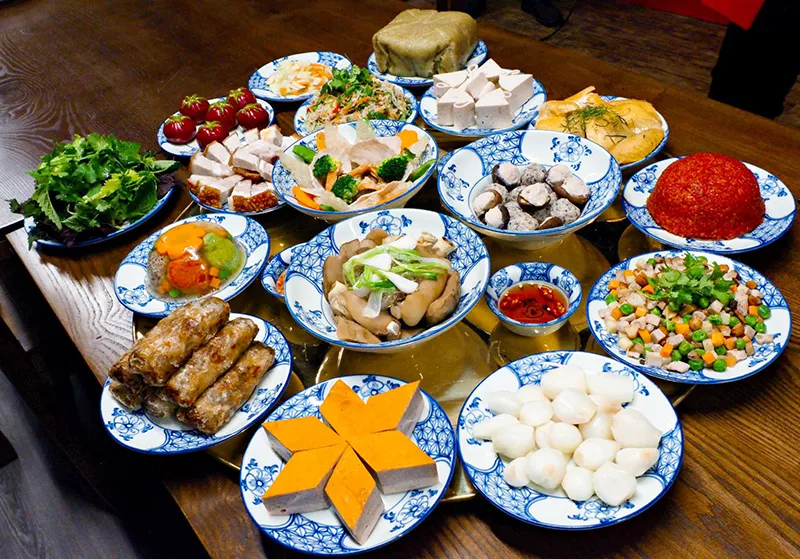
Northern Tet food is less sweet than in the South and more heavily preserved or pickled. This reflects both climate (cooler winters historically allowed preservation) and worldview: the idea that a good year begins with discipline, moderation, and control, rather than ease or abundance alone.
Meals are served formally. Dishes are placed symmetrically. Elders are served first. The act of eating is quiet and deliberate, especially on the first day of the Vietnamese lunar new year.
2/ Public Celebration in Northern Vietnam: Present, but Traditional
It is a common misconception that northern Vietnam has little public celebration during Tet. In reality, public activity does exist, but it is more traditional, ceremonial, and spatially contained compared to the South.
In Hanoi and surrounding northern provinces, public Tet activities typically include:
- Pagoda visits and temple ceremonies: From the first night onward, major temples and pagodas receive large numbers of visitors praying for health, academic success, and family stability. This is one of the most visible forms of public Tet activity in the North.
- Traditional games and folk performances: In villages and temple grounds, games such as human chess (cờ người), tug-of-war, and folk singing appear after the first day of Tet. These are structured, scheduled, and often tied to communal spaces rather than spontaneous street activity.
- Historical festivals linked to early spring: Many northern festivals technically begin during or shortly after Tet, especially those connected to village guardian spirits, agricultural cycles, or historical figures. These festivals emphasize ritual reenactment rather than entertainment.
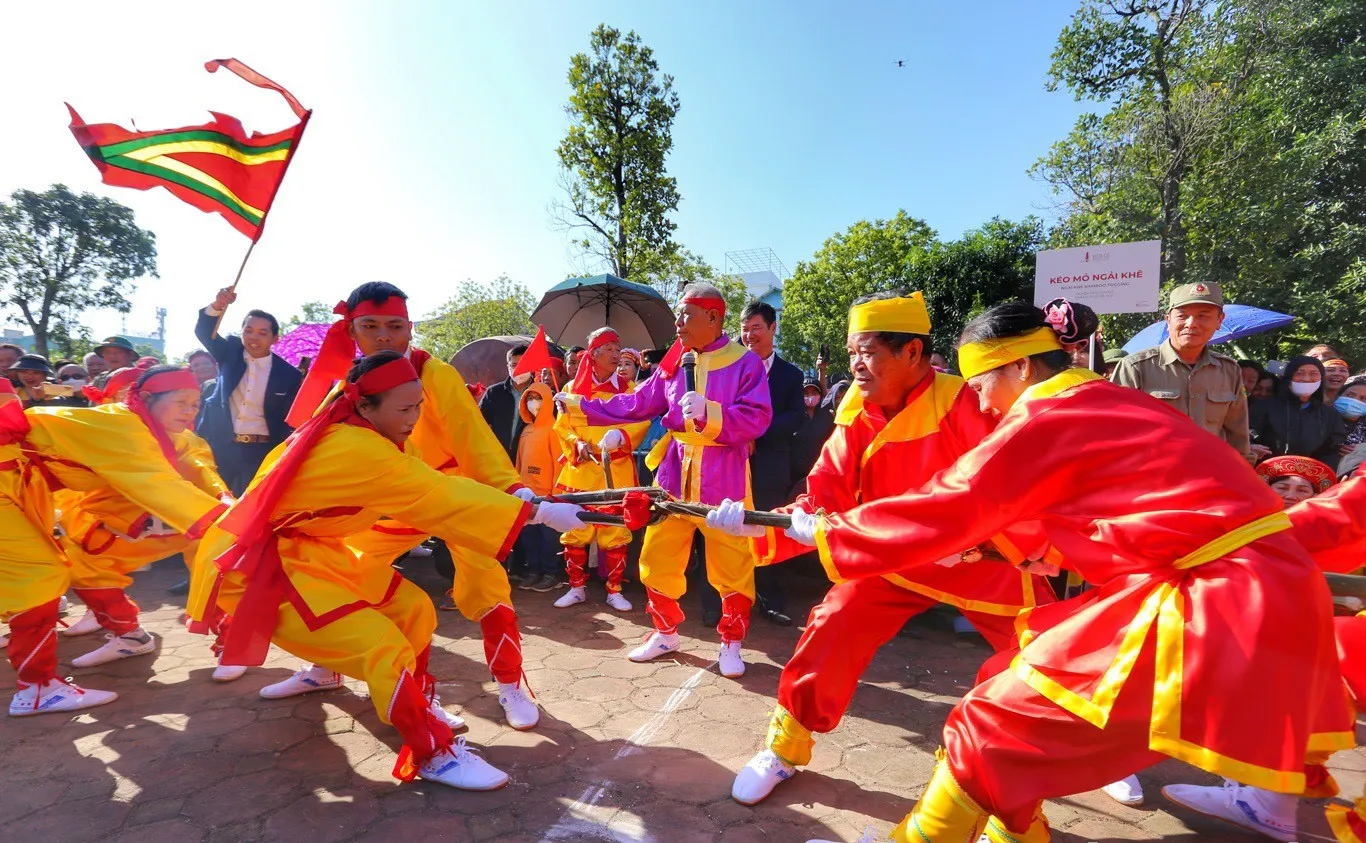
What differentiates northern public celebration during the Vietnamese lunar new year is tone, not absence. Activities are quieter, more symbolic, and often tied to spiritual or historical meaning. Loud street parties, casual drop-in celebrations, or free-form socializing are less common during the core days.
The first day remains strongly family-focused. Public life gradually expands on the second and third days, aligning with traditional beliefs about social order: family first, then community, then society.
3/ Overall Northern Tet Atmosphere
Taken together, the northern Vietnamese lunar new year feels composed rather than festive, ritual-driven rather than expressive. Celebration exists, but it unfolds within clear boundaries of time, space, and behavior.
For travelers, this means northern Vietnam during Tet offers:
- Deep authenticity
- Strong cultural continuity
- Fewer spontaneous interactions
- Greater emphasis on observation than participation
It is not less celebratory than the South, it is more intentional.
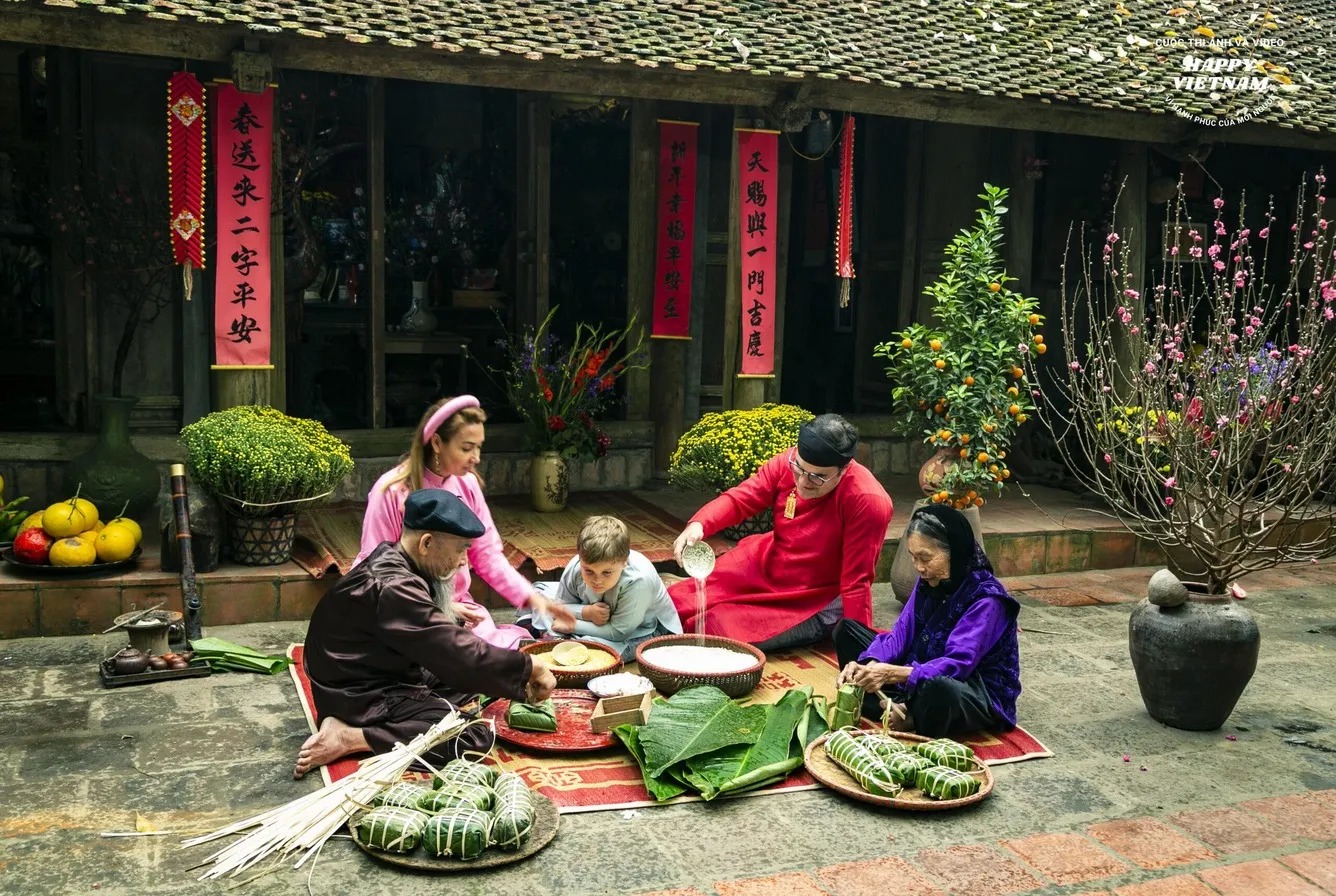
Central Vietnam: Ceremonial, Spiritual, and Shaped by Royal Legacy
In central Vietnam, the Vietnamese lunar new year carries a distinct gravity that sets it apart from both the North and the South. This region, historically exposed to harsh weather, long periods of war, and imperial rule, approaches Tết with a mindset shaped by spiritual caution, ritual precision, and historical memory.
Nowhere is this more visible than in Huế, the former imperial capital of the Nguyễn Dynasty. While Tết is celebrated across the central provinces from Quảng Bình to Quảng Nam, Huế remains the symbolic heart of Central Vietnam’s Tet identity.
1/ Central Vietnam Tet Food: Ritual, Offerings, and Moral Balance
Food during the Vietnamese lunar new year in Central Vietnam is deeply tied to ritual obligation rather than abundance. Central Tet meals are often more elaborate than in the North, but less indulgent than in the South. The guiding principle is harmony: between flavors, between the living and the ancestors, and between human life and unseen forces.
Key characteristics of Central Vietnam Tet food include:
- Small portions, many dishes: Influenced by royal cuisine, Tet meals often consist of numerous small dishes rather than a few large plates. This reflects court traditions, where refinement and balance mattered more than volume.
- Bánh tét Huế-style: While bánh tét is common across the South and Central regions, Huế versions tend to be more restrained in seasoning and presentation. The cake is often firmer, sliced carefully, and served as part of an offering rather than casual snacking.
- Pickled and fermented accompaniments: Dishes like dưa món (pickled vegetables) appear frequently. Their sourness is not incidental. It symbolizes purification and balance after rich ceremonial foods.
- Vegetarian offerings: Central Vietnam has a strong Buddhist tradition, and many households prepare vegetarian dishes specifically for altar offerings during Tet, especially on the first and fifteenth days of the lunar month.
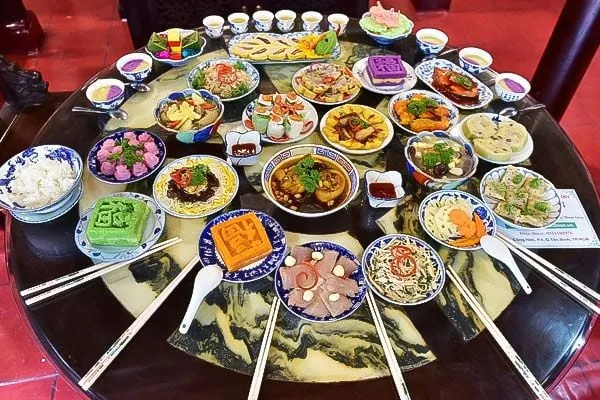
Unlike the South, sweetness is restrained. Unlike the North, preservation is not the dominant logic. Central Tet food exists in a middle ground, reflecting a worldview shaped by uncertainty, impermanence, and spiritual attentiveness.
Meals are often eaten after rituals are completed. Eating before offering food to ancestors or deities is considered inappropriate. For travelers invited into a Central Vietnamese home during Tet, food is not hospitality first, it is devotion first, sharing second.
2/ Ceremonial Language and Behavior During Central Vietnam Tet
During the Vietnamese lunar new year, Central Vietnam places strong emphasis on verbal restraint and respectful conduct. This is especially noticeable in Huế, where court etiquette historically shaped everyday speech.
Common features include:
- Polite, formal greetings
- Avoidance of loud, exaggerated emotion
- Careful choice of words and actions to avoid bad omens
People are more cautious about what is said, not just what is done. This is rooted in the belief that language carries spiritual weight during Tet, especially in regions long associated with ritual authority.
For visitors, this does not require mastering etiquette, but it does reward calmness and attentiveness.
3/ Public Celebration in Central Vietnam: Ritual Over Spectacle
Public celebration during the Vietnamese lunar new year in Central Vietnam is ritual-driven rather than expressive.
In and around Huế, typical Tet-related public activities include:
- Temple and pagoda ceremonies: These are among the most significant public gatherings during Tet. People visit to pray for health, peace, and protection: often quietly, with incense and offerings rather than loud celebration.
- Royal-inspired rituals and reenactments: In some years, cultural institutions and heritage sites organize ceremonies inspired by imperial Tet customs, such as court music (Nhã nhạc) performances or traditional rites within the Imperial Citadel.
- Community-based festivals: Smaller villages in Central Vietnam may hold Tet-linked festivals honoring guardian spirits or historical figures. These events are formal, scheduled, and bound by ritual sequence.
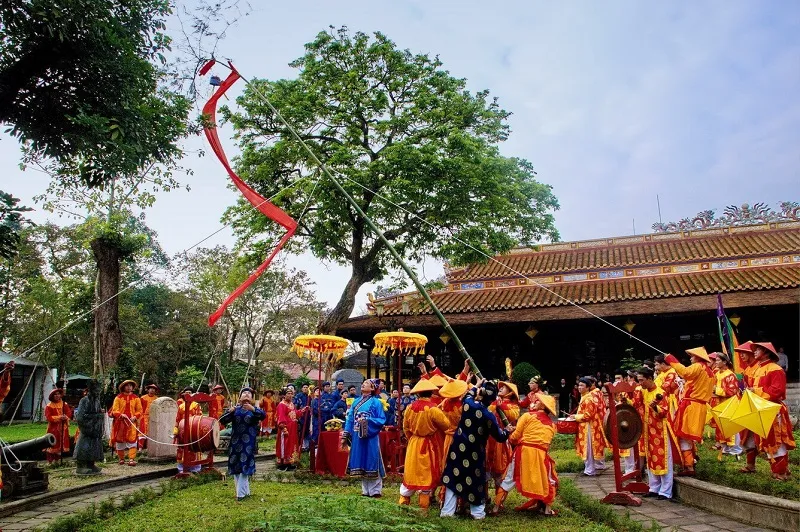
Unlike in the South, Central Vietnam does not emphasize street-level festivity during the first days of Tet. Spiritual spaces remain visibly active, drawing steady flows of visitors throughout the holiday period.
The rhythm is inward-facing but not closed. Sacred spaces, rather than streets or markets, become the center of public life.
Overall Central Vietnam Tet Atmosphere
Taken as a whole, the Vietnamese lunar new year in Central Vietnam feels solemn, attentive, and spiritually dense. It is less about reunion than the South, less about hierarchy than the North, and more about maintaining balance in an uncertain world.
For travelers, Central Vietnam during Tet offers:
- Strong spiritual atmosphere
- Deep connection to history and ritual
- Fewer casual interactions
- A sense of reverence rather than celebration
It is not the easiest region to experience Tet socially, but it is arguably the most symbolically rich.
Southern Vietnam: Open, Social, and Oriented Toward Ease and Abundance
In southern Vietnam, the Vietnamese lunar new year feels noticeably different in tone, rhythm, and social energy. While Tết remains deeply important, it is approached with a mindset shaped by migration history, agricultural abundance, and a more flexible social structure.
This is most clearly felt in Ho Chi Minh City and across the Mekong Delta, where Tết is less formal than in the North, less ceremonial than in Central Vietnam, and more outward-facing and welcoming overall.
Southern Tet does not reject ritual — it softens it.
1/ Southern Vietnam Tet Food: Sweetness, Sharing, and Comfort
Food during the Vietnamese lunar new year in southern Vietnam emphasizes abundance, generosity, and emotional comfort. Compared to the North and Central regions, southern Tet food is:
- Sweeter in flavor
- Softer in texture
- Less rigid in presentation
- More oriented toward sharing than hierarchy
This reflects both climate (year-round agriculture, fewer preservation constraints) and worldview: the belief that a good year should begin smoothly and pleasantly.
Key southern Tet foods include:
- Bánh tét (southern style): Larger, often softer than central versions, and sometimes filled with sweet ingredients such as banana or sweetened mung bean. The cylindrical shape and generous size make it ideal for slicing and sharing with visitors.
- Thịt kho tàu (braised pork with eggs in coconut water): One of the most iconic southern Tet dishes. The pork is slow-braised until tender, the eggs stained golden-brown, and the broth lightly sweet. This dish symbolizes warmth, fullness, and family cohesion.
- Canh khổ qua nhồi thịt (bitter melon soup): Despite its bitterness, this dish is eaten deliberately during Tet. The name “khổ qua” is commonly interpreted as “hardship has passed,” making it a symbolic dish for leaving difficulties behind in the old year.
- Mứt Tết (candied fruits and seeds): Southern households often prepare or buy a wide variety of candied coconut, ginger, lotus seeds, kumquat, and tamarind. These are offered continuously to guests as a sign of welcome.
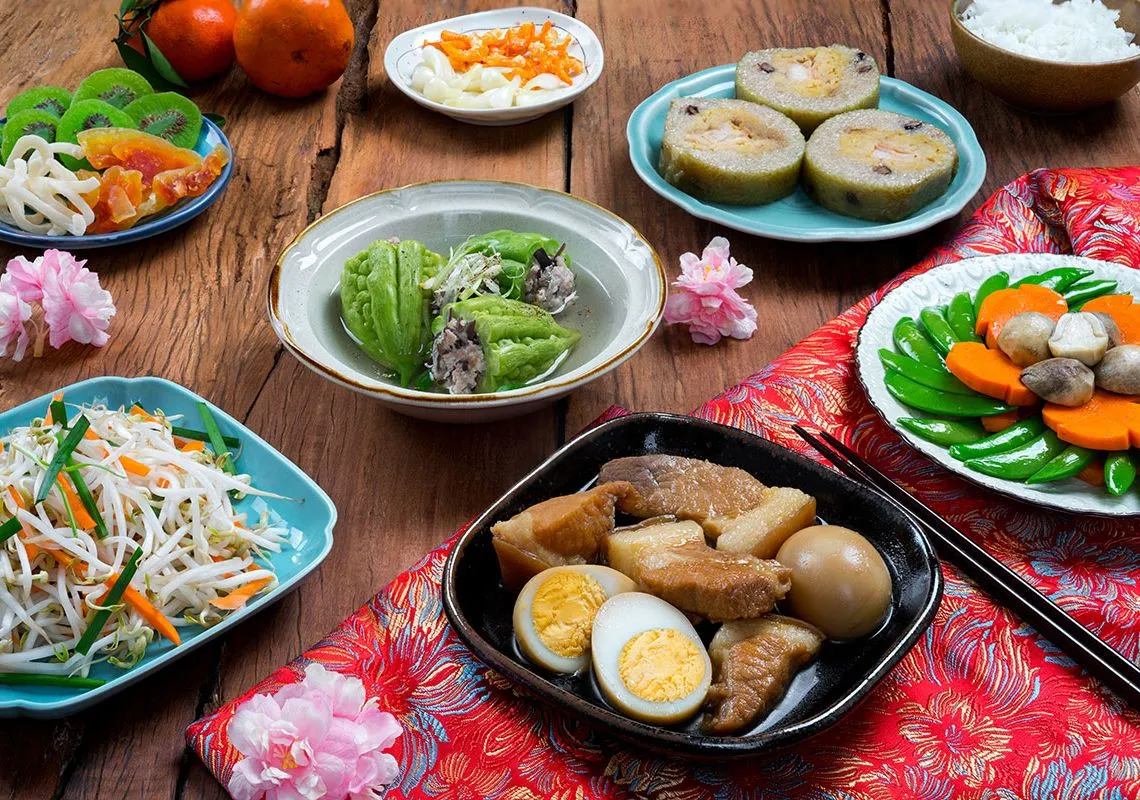
Unlike the North, where food follows order and restraint, or Central Vietnam, where food serves ritual first, southern Tet food serves a social function. Dishes are placed on the table for grazing. Visitors are encouraged to eat, snack, and linger.
Refusing food repeatedly can be seen as distancing rather than polite.
2/ Social Rhythm During the Southern Vietnamese Lunar New Year
Southern Vietnam’s approach to the Vietnamese lunar new year is shaped by centuries of migration. Much of the southern population descends from settlers who moved southward, often without deep ancestral roots in a single village. As a result, social structures are less hierarchical and more fluid.
This is reflected during Tet:
- Visiting is more spontaneous
- Guests are welcomed even without formal scheduling. Sometimes even strangers are invited
- The “right” order of visits is less rigid
- Humor, conversation, and warmth are encouraged
Children may move freely between households. Neighbors drop in casually. The line between family and social circle is often blurred.
For travelers, this makes southern Vietnam the most approachable region during Tet.
3/ Public Celebration in Southern Vietnam: Visible, Informal, and Gradual
Public celebration during the Vietnamese lunar new year is most visible in the South, but it unfolds gradually rather than explosively.
In Ho Chi Minh City and other southern cities, public Tet activity typically includes:
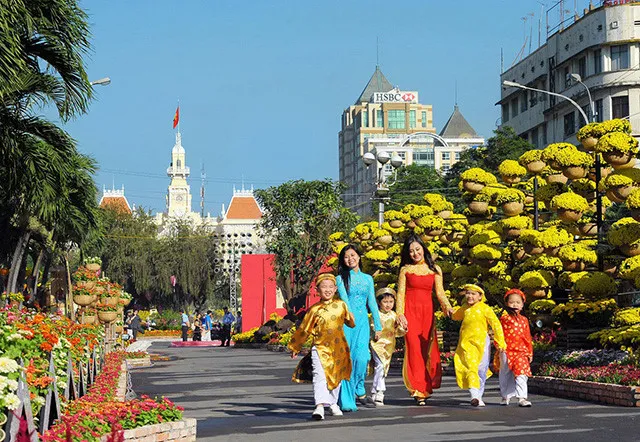
- Flower streets and public displays: Large pedestrian flower streets appear in city centers before Tet and remain open through the early days of the holiday. These spaces are designed for strolling, photography, and casual gathering rather than ritual.
- Neighborhood-level celebrations: Small lion dances, informal music, and community gatherings occur within residential areas, especially after the first day.
- Pagoda visits with a lighter tone: Southern pagoda visits are often social as well as spiritual, with families arriving together, chatting, and lingering rather than moving solemnly through rituals.
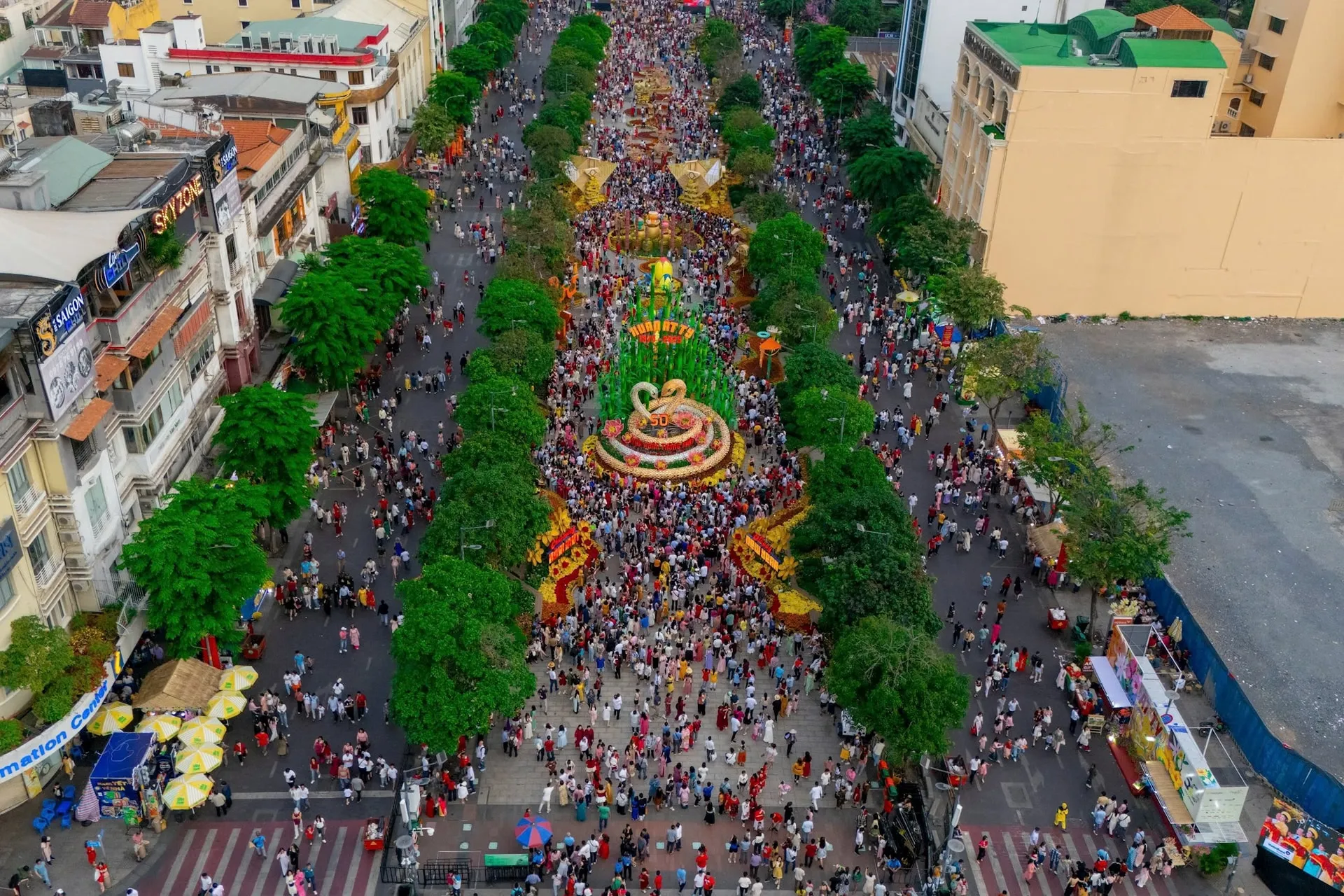
However, it is important to note that the first day of Tet remains family-focused, even in the South. Public life does not peak immediately. Activity increases on the second and third days as social visiting expands outward.
Southern public celebration feels less scripted than in Central Vietnam and less restrained than in the North, but it is still anchored in cultural logic rather than tourism performance.
4/ Language, Taboos, and Attitude in the South
Southern Vietnam tends to be more relaxed with language during Tet. While negative topics are still avoided, conversation is more playful, and laughter is common.
Greetings are warm and often informal. Compliments, jokes, and food-related talk dominate interactions.
For travelers, this means:
- Less pressure to follow strict etiquette
- Greater tolerance for mistakes
- More opportunities for genuine interaction
Respect is still expected, but it is expressed through openness rather than formality.
Overall Southern Tet Atmosphere
Taken as a whole, the Vietnamese lunar new year in southern Vietnam feels:
- Social rather than ceremonial
- Comfortable rather than restrained
- Generous rather than symbolic
- Inclusive rather than hierarchical
This does not make it “less traditional.” It makes it traditionally southern.
For travelers, southern Vietnam during Tet offers:
- The easiest entry point into Tet culture
- More visible public life
- Greater chances of interaction
- A balance between closure and celebration
It is the region where Tet is most likely to feel alive rather than observed.
Day-by-Day Breakdown of the Vietnamese Lunar New Year
The Vietnamese lunar new year unfolds according to a moral and social sequence. Each day carries a different emphasis.
New Year’s Eve (Giao Thừa)
This is the moment of transition between the old year and the new. Families gather at home. Incense is burned to send off the old year’s guardian spirits and welcome the new ones. Fireworks may appear in major cities, but the emotional center is the home altar. After the midnight celebration, some families will visit nearby temples and pagodas, wishing for health, happiness and prosperity for their loved ones.
For travelers, this is a night best observed quietly rather than “celebrated” as the streets can be quiet before the NYE, but at the same time, there will be a big crowd gathering at the center in big cities doing a countdown so if you’re looking for a place to celebrate, that’s the place to be.
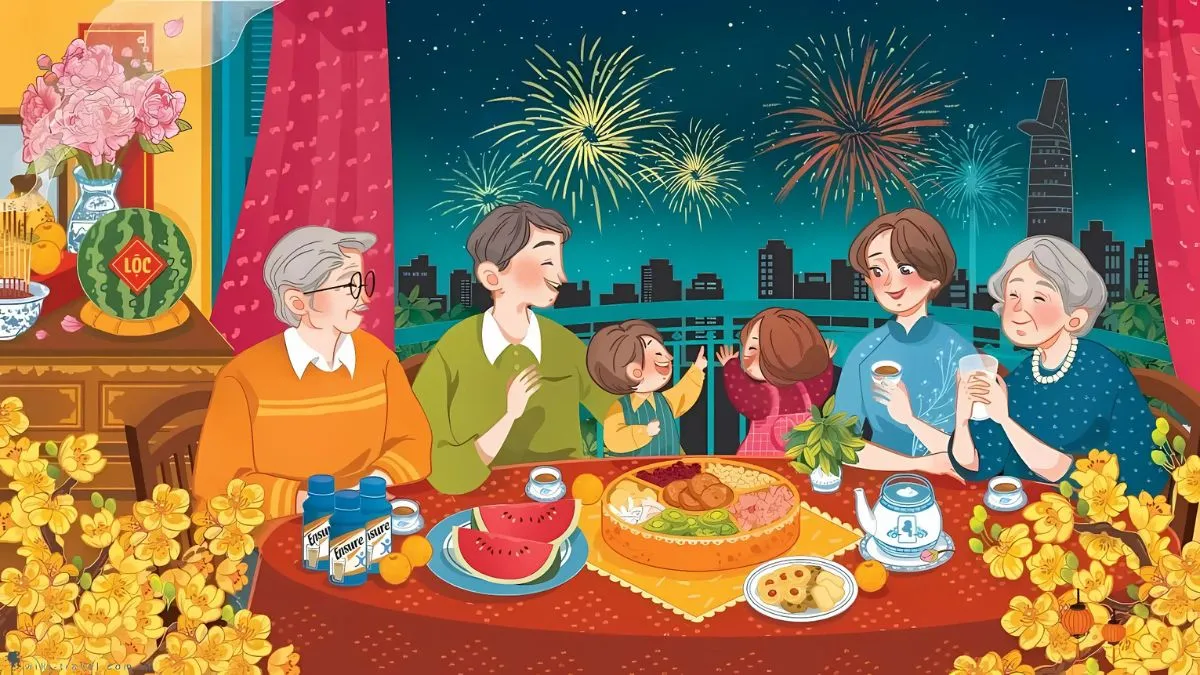
Day One: Family First
The first day of the Vietnamese lunar new year is the most symbolically important day of the entire holiday. It is reserved almost exclusively for immediate family, and the way this day unfolds is believed to set the emotional and moral tone for the year ahead.
The morning usually begins quietly. Children and younger family members formally greet parents and grandparents, often with well-rehearsed New Year wishes focused on health, longevity, and peace. Respect is expressed through posture, tone of voice, and sequencing; elders are always addressed first. In return, children receive lì xì (red envelopes) as a blessing rather than a reward.
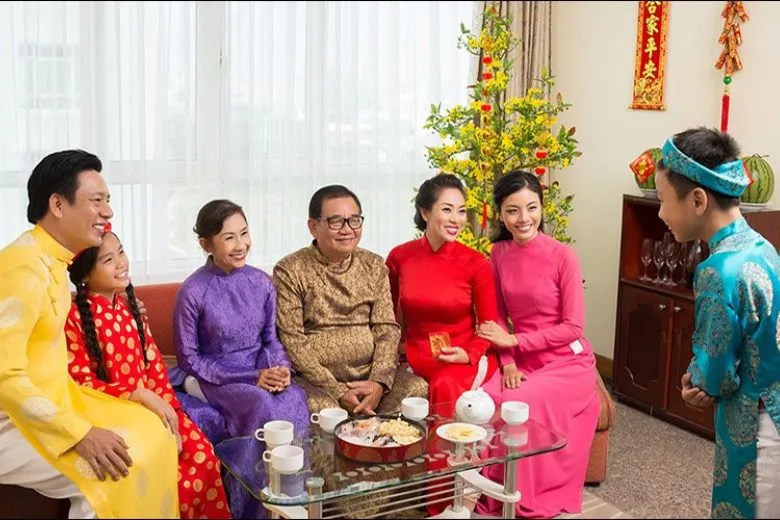
Meals on the first day are deeply symbolic. The main New Year’s meal is usually eaten at home, surrounded by close family, and prepared in advance as part of Tet rituals. This meal is not about variety or extravagance; it is about continuity: eating familiar dishes that connect generations and reaffirm belonging. Conversation tends to be calm and positive. Sensitive topics are avoided deliberately.
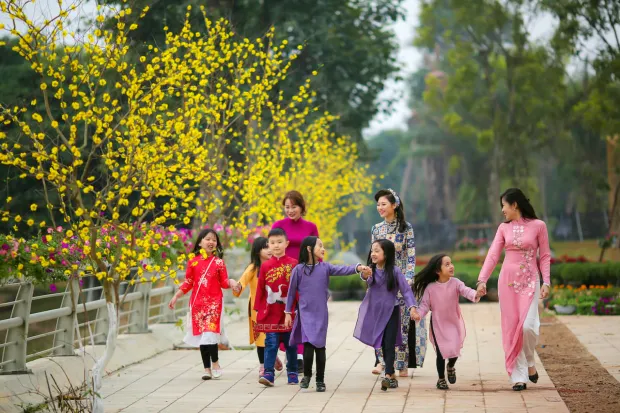
In many cities, after the main meal, families may go out together for a gentle walk rather than social visits. Common destinations include:
- Flower exhibitions and flower streets
- Public parks
- Nearby pagodas or temples
These outings are slow, observational, and multigenerational. The goal is not activity but presence: being together in a calm, auspicious environment.
This is why cities often feel unusually empty and quiet on the first day of the Vietnamese lunar new year. Shops are closed, traffic is minimal, and streets lack their usual urgency. This is not accidental. People are exactly where they believe they should be: inside the family circle, resetting relationships before engaging with the wider world again.
Day Two: Extended Family, Teachers, and Social Obligations
The second day of the Vietnamese lunar new year marks a deliberate widening of social space. While Day One centers on the nuclear family, Day Two is traditionally dedicated to extended family, respected elders outside the household, and teachers.
Visiting relatives becomes appropriate on this day, particularly:
- Aunts, uncles, and cousins
- In-laws
- Elder family friends
In Vietnamese culture, these relationships are not casual. Visiting on the correct day is a way of reaffirming bonds and maintaining long-term social harmony.
Teachers occupy a particularly important position during Tet. Rooted in Confucian tradition, teachers are viewed as moral guides, not just educators. Visiting or sending New Year wishes to former teachers on Day Two is a way of acknowledging intellectual and ethical debt. Even in modern urban life, this practice remains common, especially among families with school-aged children.
The tone of Day Two is noticeably more relaxed than Day One. Formality softens. Laughter becomes more common. Meals may be shared between households rather than strictly at home. Children move more freely between relatives’ houses, carrying red envelopes and exchanging greetings.
Cities begin to show signs of life again. While many businesses remain closed, streets are no longer silent. Cafés may reopen partially. Parks and public spaces see more foot traffic. The city feels gently social, though still far from normal pace.
Day Three: Society, Friendship, and Spiritual Renewal
By the third day of the Vietnamese lunar new year, the social circle expands fully outward. This day is traditionally associated with friends, colleagues, community spaces, and spiritual life.
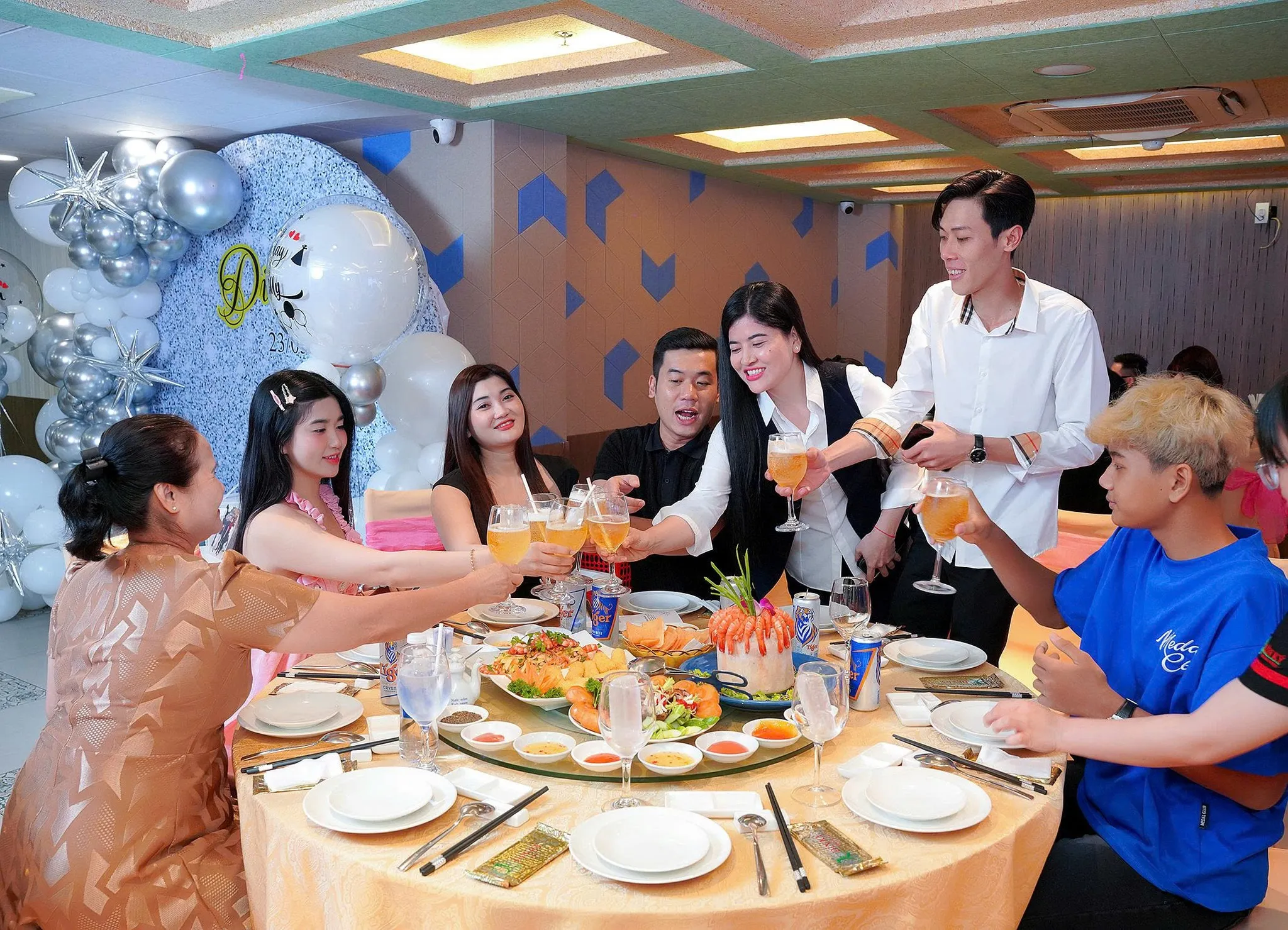
Visits to friends become appropriate, especially those outside family structures. These visits are more casual and less hierarchical. Food is shared informally. Conversations range beyond ritual greetings to reflections on the year ahead, travel plans, work, and hopes.
Pagodas and temples are especially active on Day Three. Many people choose this day to:
- Pray for health, stability, and clarity
- Make offerings for the coming year
- Seek emotional grounding after the intensity of family-focused days
These visits are not only religious but also psychological. They mark a transition from inward focus to outward intention.
From an economic standpoint, Day Three is when life begins to reboot. Some small businesses reopen, often selectively. Shop owners may perform small rituals before opening to symbolically invite good fortune. Street activity increases, though the pace remains slower than usual.
For travelers, Day Three is often the moment when the city feels approachable again. Transportation becomes easier. Restaurants reopen gradually. Public spaces regain their rhythm.
In cultural terms, Day Three completes the arc of Tet:
- Day One: family and moral reset
- Day Two: obligation and social continuity
- Day Three: community, spirituality, and forward motion
After this point, Tet slowly dissolves into normal life, carrying its symbolic weight into the months ahead.
Tet Taboos and Language Etiquette (What Not to Do or Say)
During the Vietnamese lunar new year, words and actions are believed to carry amplified weight.
Common taboos include:
- Talking about death, illness, or financial loss
- Arguing or raising one’s voice
- Breaking objects
- Wearing dark or somber clothing on the first day
Language matters. Vietnamese people consciously choose positive phrases and avoid negative expressions during the first days of Tet.
For travelers, the key is not memorization but awareness. Calm behavior and neutral language are always appreciated.
Money, Luck, and Business Logic During Tet
Tet represents a temporary suspension of economic urgency.
Businesses close not because demand disappears, but because Tet is the time for people to rest and enjoy the holidays after a year of hard work. Reopening is often staggered and may involve small rituals to “open luck” for the year. Some businesses even wait for the “right” day to reopen.
Cash flow increases before Tet and drops sharply during it. This is why:
- ATMs may run low on cash due to people getting the notes for the lucky money.
- Banks close for extended periods.
For travelers, carrying sufficient cash before Tet begins is recommended.
Where Travelers Should Be in Vietnam During the Vietnamese Lunar New Year
There is no single “best” place, only the right match for expectations.
- Ho Chi Minh City: Best balance of culture and functionality
- Hoi An: Beautiful but can be quiet
- Hanoi: Authentic but can be a bit reserved
- Beach destinations: Operational and relaxed
If your goal is cultural understanding, arrive before Tết. If your goal is rest, arrive during it.
Practical Things Travelers Must Know
- Flights and buses before Tết sell out early
- Prices rise slightly before Tết, normalize after
- ATMs may run low on cash
- Many small businesses close without notice
- Fun fact: Crime rates typically drop during Tết
Patience is essential. Tết is not designed around visitor convenience.
Experiencing the Vietnamese Lunar New Year Atmosphere in Saigon Before Tết
The most revealing moment of the Vietnamese lunar new year for travelers is often before it officially begins.
In the days leading up to New Year’s Eve, Saigon is alive with preparation: flower markets, residential shopping runs, busy street vendors, and families moving through the city together.
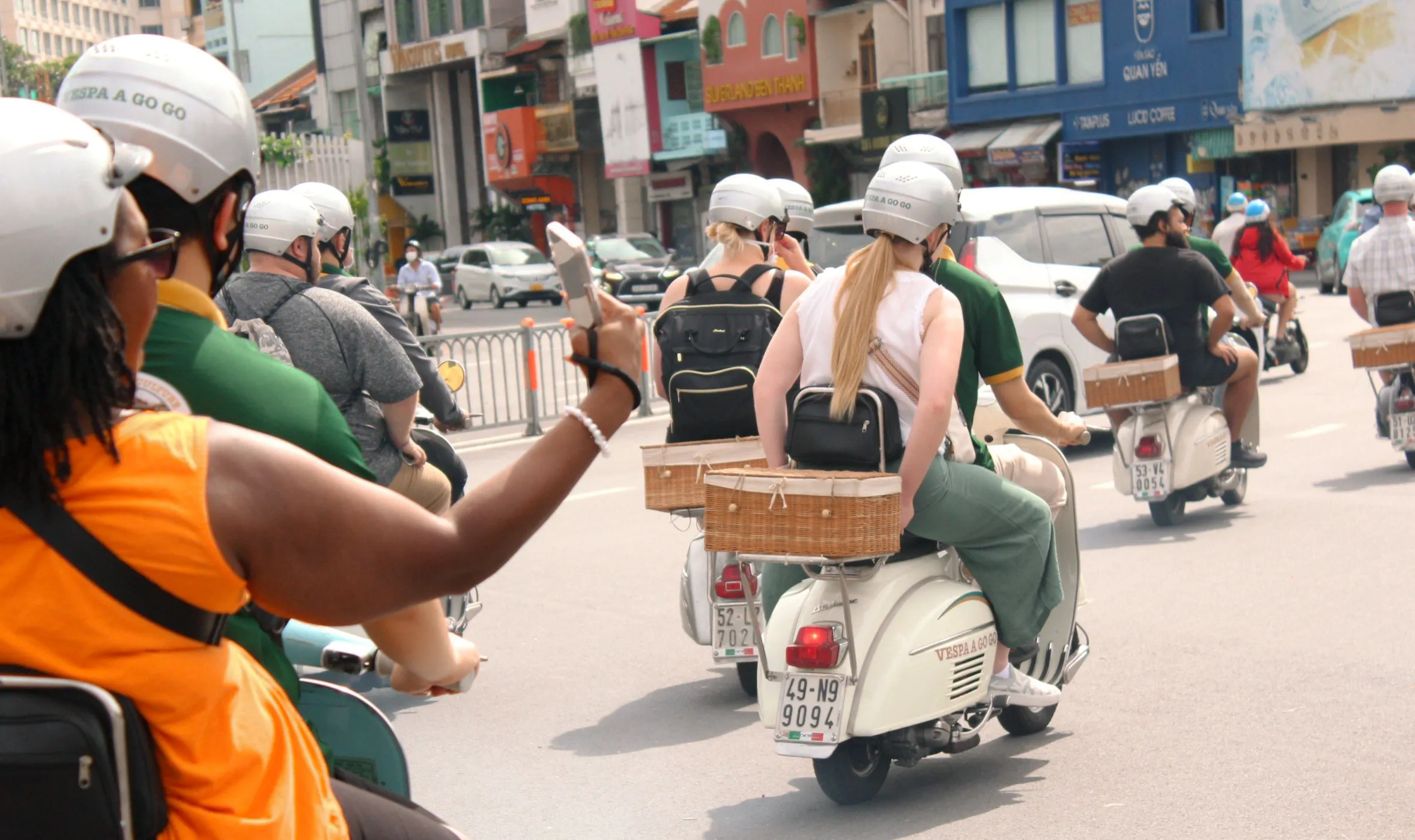
Experiencing this period by moving with the city rather than observing it from fixed points makes a significant difference. This is where riding through neighborhoods on vintage scooters with local guides, allows visitors to see preparation rather than performance.
This is not about celebration. It is about witnessing a city collectively preparing to pause.
Final Thoughts: Understanding the Vietnamese Lunar New Year in 2026
The Vietnamese lunar new year is not a spectacle designed to impress outsiders. It is a social reset, a moral checkpoint, and a deeply personal moment repeated across millions of households.
If you approach Tết expecting entertainment, you may be disappointed. If you approach it seeking understanding, it becomes one of the most meaningful times to be in Vietnam.
Come early. Observe quietly. Adjust expectations. During the Vietnamese lunar new year, Vietnam is not closed. It is home.

Anh Pham - General Manager
After exploring Ho Chi Minh City (or Saigon, as I love to call it) on a motorbike for over 10 years, these streets feel like my playground. I believe the best travel moments happen when you discover something unexpected. My goal is simple: to share my favorite parts of the city with you, so you can experience the real, everyday magic of my home.
Other tips
- 10 Best Vietnamese Clothing Brands & Local Brands Vietnam
- Beaches Near Hanoi: The Closest Beach Escapes for a Weekend Trip
- Hoi An Tailors: The Complete Insider Guide to Custom Clothes in Vietnam
- Best eSIM for Vietnam (2026 Guide from a Local Perspective)
- Da Nang International Airport Vietnam: A First-Timer Guide to Landing Calmly (DAD)
- Noi Bai International Airport Guide for First-Time Travelers to Vietnam (HAN)
- Traveling Vietnam as a Couple: What to Do, Where to Go, and How It Actually Feels
- Vietnamese Lunar New Year (Tết) 2026
- Vietnamese Mountain Guide
- Best Beaches in Vietnam: How the Coast Actually Works (and How to Choose the Right One)
- 15 Underrated Towns in Vietnam
