
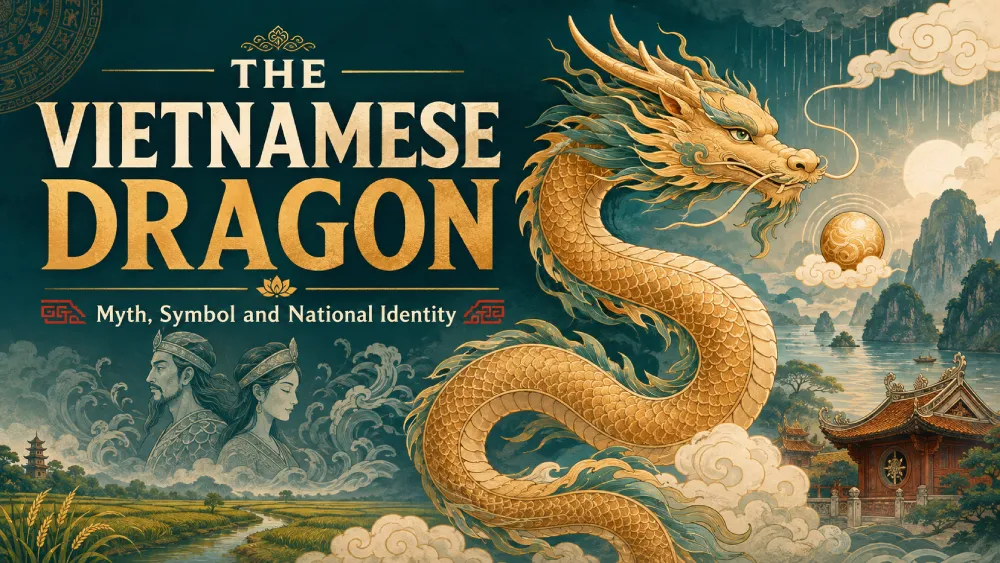
No other nation in the world takes such deep pride in calling itself the “descendants of the dragon” as Vietnam. The Vietnamese dragon (rồng) is far more than a mythical creature: it is an ancestor, a deity, a symbol of national unity, and the very soul of Vietnamese identity. Unlike the fearsome, fire-breathing beasts of Western legend, the Vietnamese dragon is benevolent, a bringer of rain, a protector of the land, and a guardian of the rice fields. This guide explores its origins, its legends, how it evolved through the dynasties, and why it remains central to Vietnamese culture today.
What Does the Dragon Symbolise in Vietnamese Culture?
Quick answer: The Vietnamese dragon symbolises power, prosperity, protection and the divine origin of the Vietnamese people. Associated with water and rain, it’s a benevolent bringer of good harvests rather than a monster. It represents the emperor, national strength, and the yang energy of life and growth, and leads the Four Sacred Animals.
In Vietnamese belief, the dragon is overwhelmingly positive, a sharp contrast to its Western counterpart. It is, first and foremost, a benevolent force. Closely tied to water, the dragon was venerated as the bringer of rain, essential to a rice-growing civilisation, and a protector against floods and droughts. This dual role as both provider and protector made it central to survival and prosperity in the deltas of the Red River and the Mekong.
Beyond agriculture, the dragon represents the emperor and the power of the nation, symbolising yang energy, the universe, life and growth. It leads the Four Sacred Animals (Tứ Linh): the Dragon (Long), Unicorn/Qilin (Lân), Tortoise (Quy) and Phoenix (Phụng). As the only mythical creature among them and the only legendary animal in the twelve-animal zodiac, the dragon holds the most revered status of all, able to fly in the sky, swim underwater and walk on land.
What Is the Legend of “Con Rong Chau Tien”?
Quick answer: “Con Rong Chau Tien” (Children of the Dragon, Grandchildren of the Fairy) is Vietnam’s founding myth. The sea-dragon king Lac Long Quan married the mountain fairy Au Co, who bore 100 eggs hatching into 100 sons. They parted, each taking 50 children to the sea and mountains, and their eldest son became the first Hung King, ancestor of the Vietnamese.
This is the legend at the very heart of Vietnamese identity. According to the ancient origin myth, the dragon king Lạc Long Quân married the fairy goddess Âu Cơ, who bore 100 eggs that hatched into 100 sons. Lạc Long Quân, of the dragon lineage, belonged to the sea; Âu Cơ, of the fairy lineage, belonged to the mountains. Though they came from opposite worlds, their union harmonised the great extremes of the universe: water and land, dragon and fairy, sea and mountain.
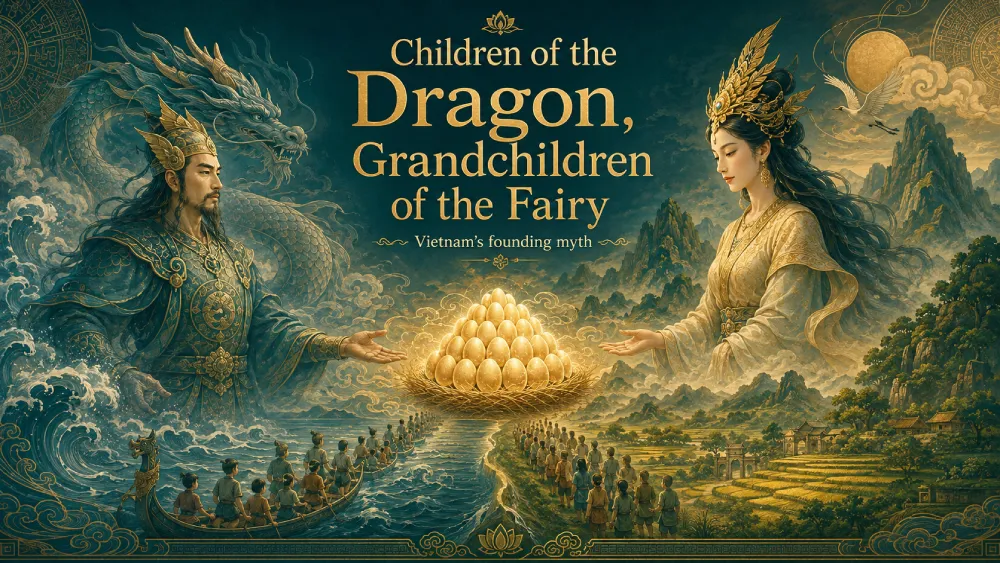
In time, the two parted amicably, each taking 50 children, Âu Cơ to the mountains and Lạc Long Quân to the sea, thus populating the coasts and highlands of the Lạc Việt. Their eldest son became the first Hùng King, founder of Vietnam’s first dynasty. This is the origin of the cherished proverb “Con Rồng, cháu Tiên” (Children of the Dragon, Grandchildren of the Fairy). For the Vietnamese, the dragon is therefore not merely a symbol but a genealogy, a literal claim of shared, divine ancestry that has bound the nation together for millennia.
What Is the Difference Between “Rồng” and “Long”?
Quick answer: Vietnamese uses two words for dragon, reflecting its layered culture. “Rồng” is the pure Vietnamese (Nom) word, born from rural villages and folk tales, evoking closeness, rice fields and rain. “Long” is the Sino-Vietnamese (Han) term, more formal and scholarly, used in royal, literary and place names like Thang Long (Hanoi) and Ha Long.
The Vietnamese language reveals the dragon’s dual nature through two distinct words. Rồng is the native Vietnamese (Nom) word, born from village life and fairy tales told by the hearth. It feels close and earthy, associated with natural phenomena and folk belief, where the dragon is a guardian of rice fields and a symbol of fertility and prosperity.
Long is the Sino-Vietnamese (Han) term, more formal, scholarly and majestic, used in royal contexts, literature and the names of places that carry deep aspiration. The capital Thăng Long (the old name of Hanoi) means “ascending dragon,” signifying the rise of an independent nation, while Hạ Long means “descending dragon,” symbolising protection of the homeland’s seas. This two-word structure shows how the dragon lives in both the humblest folk imagination and the loftiest expressions of national identity.
How Did the Vietnamese Dragon Evolve Through the Dynasties?
Quick answer: The dragon’s image changed with each era. Early dragons were short and crocodile-like. The Ly dynasty (11th-13th c.) created a slender, graceful dragon symbolising refinement and Buddhism. The Tran dragon grew stronger and more martial. The Le and Nguyen dragons became more powerful and ornate, with five claws reserved for the emperor. Each form mirrored its age.
One of the most fascinating aspects of the Vietnamese dragon is how its appearance evolved across the dynasties, each reflecting the spirit of its time. Several Vietnamese dragon myths were born as early as the Bronze Age in the Red River basin, with the earliest dragons depicted as short, crocodile-like creatures, reflecting a people who lived by rivers and venerated crocodiles.
The image then refined dramatically over time:
- Lý dynasty (1009-1225). The classic graceful dragon emerged: slender, sinuous and flowing, with a body of 12 sections (symbolising the 12 months), a long mane, and no horns. It reflected an era of Buddhism and culture, when Vietnam’s first university was founded.
- Trần dynasty (1225-1400). The dragon grew bigger and stronger, gaining horns and a more martial bearing, mirroring an age defined by repelling Mongol invasions.
- Lê and Nguyễn dynasties. Dragons became increasingly powerful and ornate, with five sharp claws reserved exclusively for the emperor. The Nguyễn dragon, with its spiral tail and fiery sword-fin, is considered the typical form of the Vietnamese dragon.
This evolution makes the dragon a living timeline of Vietnamese history, visible in the temples, pagodas and palaces that survive today.
Why Is the Dragon Dance Performed at Tet and Festivals?
Quick answer: The dragon dance carries deep meaning beyond entertainment. Its thunderous drumbeats are believed to awaken life and drive away evil spirits, who fear loud noise. The “dragon chasing the pearl” symbolises the pursuit of wisdom and luck, and the dance reenacts the dragon playing with clouds, a prayer for favourable rain and a good harvest.
Many visitors are captivated by the dragon dance at Lunar New Year and festivals, but few realise how layered its meaning is. Far from mere spectacle, it serves several spiritual purposes. The powerful, rhythmic beat of the dragon-dance drums is believed to awaken all things and dispel “yin” energy and evil spirits, who are said to fear loud noises, cleansing the space for the year ahead.
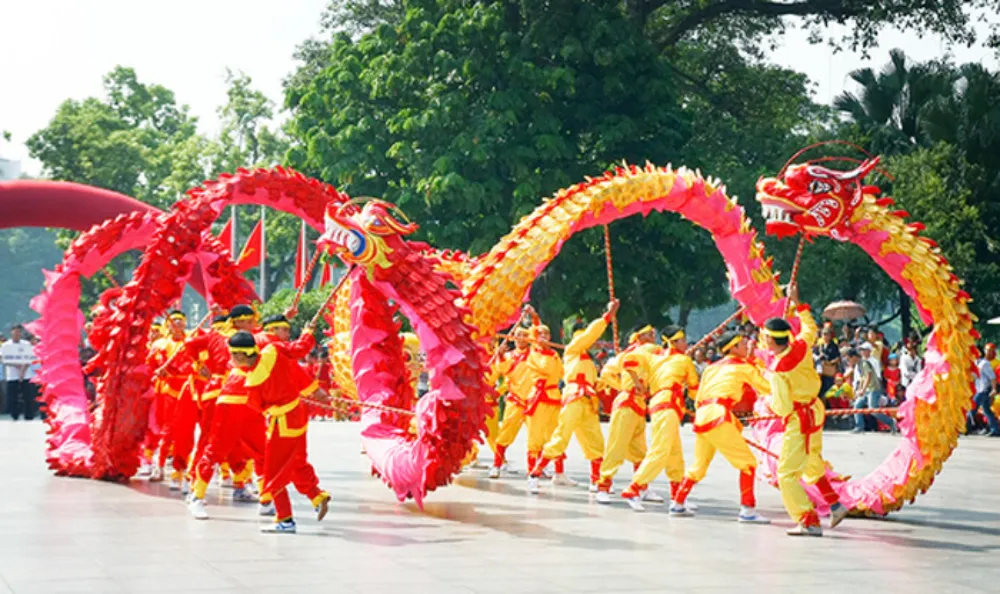
The imagery carries meaning too: the motif of “Long hý châu” (the dragon chasing the pearl) symbolises humanity’s pursuit of wisdom and good fortune, while the dance reenacts the dragon playing among the clouds, a prayer for “favourable rain and harmonious winds” (mưa thuận gió hòa), the foundation of prosperity in a rice-growing culture. To witness a dragon dance is to see an ancient agricultural prayer brought vividly to life. For more on the festival where you’ll see it most, read our guide to the Vietnamese Lunar New Year (Tet).
Where Can You See Vietnamese Dragons Today?
Quick answer: Dragons are everywhere in Vietnam, from ancient temples, pagodas and the Imperial City of Hue to modern landmarks. The most striking modern example is the Dragon Bridge (Cau Rong) in Da Nang, which breathes real fire and water during weekend evening shows. You’ll also spot dragons in architecture, art, festivals and state symbols.
The dragon is not a relic of the past but a living presence across Vietnam. Historically, you’ll find it carved into the columns of temples and pagodas, adorning the throne rooms and gates of the Imperial City of Hue, and preserved in UNESCO-listed sites featuring dragon motifs from the Lý and Trần dynasties.
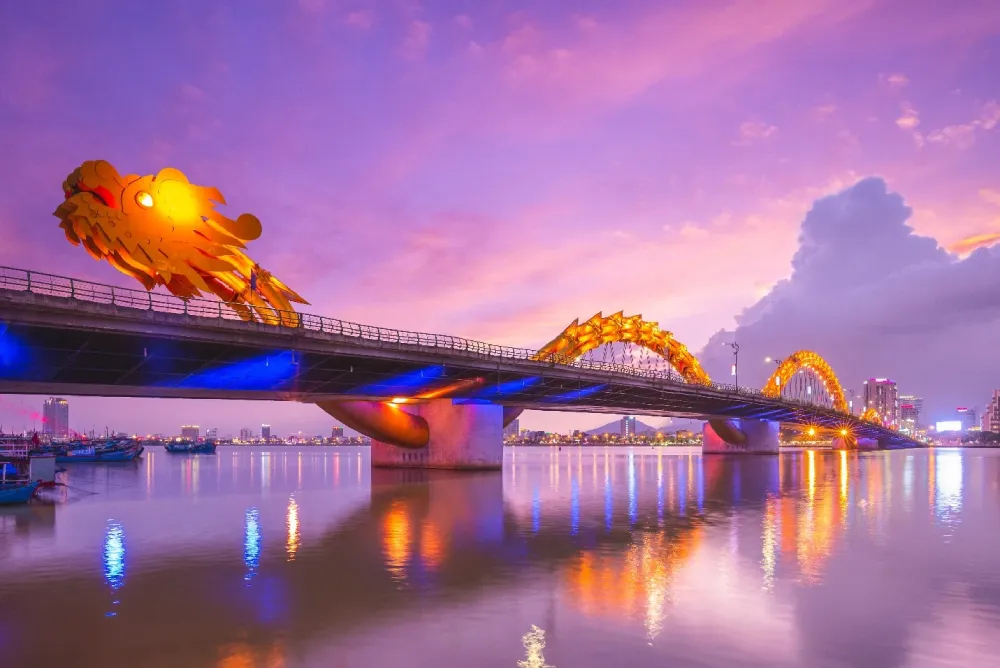
In modern Vietnam, the dragon continues to inspire. The most spectacular example is the Dragon Bridge (Cầu Rồng) in Da Nang, an architectural marvel shaped like a dragon flying across the river, which actually breathes fire and water during its weekend evening shows. Beyond landmarks, dragons appear in government seals, corporate logos, festival decorations and traditional ceremonies, from wedding trays decorated with dragon and phoenix to the dragon torches of folk festivals. The creature remains a vibrant thread connecting Vietnam’s ancient heritage to its forward-looking spirit.
What Are the Nine Sons of the Dragon?
Quick answer: In East Asian legend localised by the Vietnamese, the dragon has nine sons, each with a unique shape and personality used in architecture and daily life. None look exactly like their father. Examples include Bị Hí (turtle-like, immense strength, often seen carrying stelae) and others associated with bells, roofs, gates and locks, each placed where its nature suits.
A lesser-known but fascinating piece of dragon lore is the legend of its nine sons (cửu long tử). According to East Asian legends adapted by the Vietnamese, the dragon fathered nine sons, none of whom looks exactly like their father, with each having a distinct form and temperament that determined where it was used in architecture and everyday objects.
For example, Bị Hí, the firstborn, is shaped like a turtle with immense strength, which is why dragon-turtle figures are often placed beneath heavy stone stelae in temples. Other sons are associated with specific domains, appearing on bells, rooftops, gateways, locks and musical instruments, each chosen because its nature matched the object’s purpose. This rich system of symbolism meant the dragon’s presence was woven subtly throughout traditional Vietnamese architecture and craftsmanship, a detail many visitors walk past without realising. Recognising these motifs adds a wonderful extra layer to exploring Vietnam’s temples and historic buildings.
How Does the Dragon Appear in Vietnamese Daily Life and Language?
Quick answer: The dragon permeates Vietnamese life beyond temples and festivals. It appears in countless place names, idioms and proverbs, in wedding customs (dragon-and-phoenix trays symbolising the couple), in the zodiac (the Year of the Dragon is especially auspicious for births), and in art, ceramics and everyday decoration, reflecting its status as a beloved national symbol.
The dragon’s influence reaches into the everyday fabric of Vietnamese life and speech. It appears in numerous place names across the country and in colourful idioms, such as the saying that gently mocks someone who “talks like a climbing dragon but works like a cat’s vomit,” criticising those who talk big but achieve little.
In customs, the dragon pairs with the phoenix as a symbol of marriage: at engagement ceremonies, families traditionally carry gift trays decorated with the dragon (representing the groom) and phoenix (representing the bride) to the ancestral altar. In the zodiac, the Year of the Dragon is considered especially auspicious, and many couples hope to have children born in it. And from ceramics and carvings to paintings and festival decorations, the dragon remains a beloved motif in art and craft. Far from being a distant myth, the dragon is a living presence Vietnamese people encounter, and take pride in, throughout their lives.
How Does the Vietnamese Dragon Differ from the Chinese Dragon?
Quick answer: While related and both benevolent, the Vietnamese dragon (rồng) is increasingly recognised as a distinct tradition, not a derivative. Vietnamese uniquely claim the dragon as a literal ancestor through the “Con Rong Chau Tien” myth, and gave their capital its name (Thang Long). Vietnamese dragons also have their own evolving artistic forms across the dynasties.
It’s a common question, and an important one for understanding Vietnamese identity. While the Vietnamese and Chinese dragons share roots and a benevolent character, and influenced each other across the region, the Vietnamese dragon has its own distinct tradition. What sets it apart most is the depth of identity attached to it: no other culture claims the dragon as a literal ancestor the way the Vietnamese do through the “Con Rồng, cháu Tiên” myth, or names its capital after the creature, as with Thăng Long. Artistically, too, the Vietnamese dragon developed its own forms across the Lý, Trần, Lê and Nguyễn dynasties. As global interest in Southeast Asian culture grows, the rồng is increasingly recognised as one of the world’s great dragon traditions in its own right.
The Enduring Spirit of the Vietnamese Dragon
From the founding myth of “Con Rồng, cháu Tiên” to the fire-breathing Dragon Bridge of Da Nang, the dragon weaves through every layer of Vietnamese life: spiritual, historical, artistic and personal. It teaches that knowing where you come from is the foundation of knowing who you are, and that true power, like the dragon’s, serves and protects the people rather than conquering them. To understand the Vietnamese dragon is to understand the soul of Vietnam itself. To explore the other symbols that define the nation, see our guide to Vietnam’s symbolism.
The best way to feel Vietnam’s living culture is up close, in its temples, alleys and stories, with a local guide. Explore Saigon’s hidden heritage on the Saigon’s Untold Stories tour »
Frequently Asked Questions
What does the Vietnamese dragon symbolise? The Vietnamese dragon symbolises power, prosperity, protection and the divine origin of the Vietnamese people. Associated with water and rain, it’s a benevolent bringer of good harvests, not a monster. It represents the emperor and national strength, and leads the Four Sacred Animals (Tứ Linh).
What is the legend of Con Rong Chau Tien? It’s Vietnam’s founding myth: the sea-dragon king Lạc Long Quân married the mountain fairy Âu Cơ, who bore 100 eggs hatching into 100 sons. They parted, each taking 50 to the sea and mountains, and their eldest son became the first Hùng King. Vietnamese call themselves “Children of the Dragon, Grandchildren of the Fairy.”
Why do Vietnamese call themselves descendants of the dragon? Because of the “Con Rồng, cháu Tiên” origin myth, in which all Vietnamese descend from the union of the dragon king Lạc Long Quân and the fairy Âu Cơ. This makes the dragon a literal ancestor and a powerful symbol of national unity, shared identity and divine origin.
Is the Vietnamese dragon the same as the Chinese dragon? They’re related and both benevolent, but the Vietnamese dragon (rồng) is its own distinct tradition. Vietnamese uniquely claim it as a literal ancestor and named their capital Thăng Long (“ascending dragon”) after it. Vietnamese dragons also developed their own artistic forms across the dynasties.
Where can I see Vietnamese dragons in Vietnam? Dragons appear in ancient temples, pagodas and the Imperial City of Hue, as well as modern landmarks. The most famous is the Dragon Bridge (Cầu Rồng) in Da Nang, which breathes fire and water during weekend evening shows. You’ll also see them in festivals, dragon dances, architecture and art nationwide.