

If you’re in Vietnam in early September, you’ll feel a real change in the air. The big cities turn lively and festive, streets draped in red, soldiers practising in the parks, an unmistakable energy everywhere. Maybe you’re sitting in a coffee shop watching it unfold and wondering: “So, what’s actually happening on 2/9 in Vietnam? Why is everything suddenly red? Who’s the kind-faced man on all the posters?” Don’t worry, this isn’t a dry history lesson. Think of it as a friendly chat that gives you the inside scoop on everything you’re seeing.
What Is September 2nd in Vietnam?
Quick answer: September 2nd is Vietnam’s National Day (Quốc Khánh), marking the day in 1945 when President Hồ Chí Minh read the Declaration of Independence in Hanoi’s Ba Đình Square, founding the modern nation. It’s one of Vietnam’s two biggest patriotic holidays, alongside Reunification Day on April 30th.
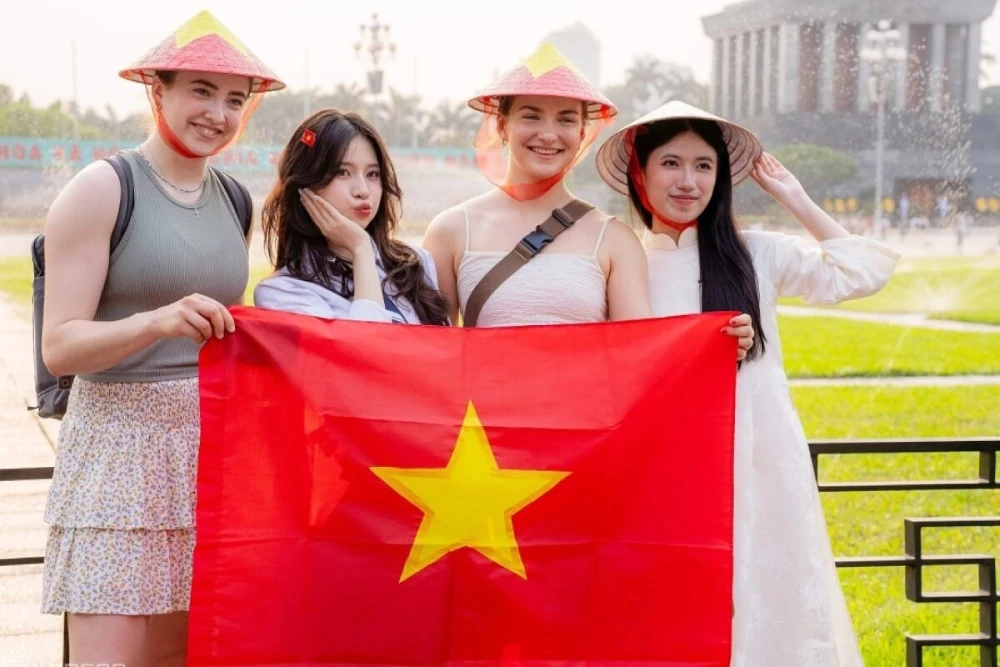
National Day, written locally as “2/9,” is the anniversary of the birth of independent Vietnam. It’s both solemn and joyous, a day of parades and flag-raising in the morning, and street parties, concerts and fireworks by night. Alongside Reunification Day on April 30th, it’s one of the two most spectacular public holidays on the Vietnamese calendar.
What Happened on September 2nd, 1945?
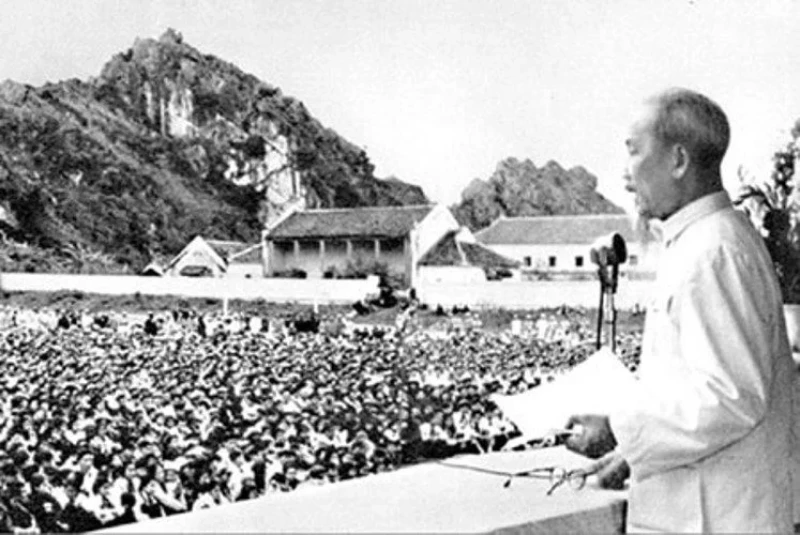
Quick answer: On 2 September 1945, in Hanoi’s Ba Đình Square, Hồ Chí Minh read Vietnam’s Declaration of Independence before a crowd of around half a million people, proclaiming the Democratic Republic of Vietnam. He opened by quoting both the American Declaration of Independence (1776) and the French Declaration of the Rights of Man (1791).
Picture a sea of people, by many accounts around half a million, filling Ba Đình Square on a humid afternoon. Red flags with gold stars flutter everywhere; the air buzzes with anticipation. The moment came after the August Revolution: as Japan’s WWII surrender became certain, the Việt Minh, a broad coalition of communists, nationalists, peasants and intellectuals led by Hồ Chí Minh, swept into Hanoi in late August 1945 and took control of the country, ending both Japanese occupation and decades of French colonial rule.
Then Hồ Chí Minh appears and begins, “Hỡi đồng bào cả nước!” (“To all my fellow countrymen!”). He reads the Declaration of Independence, opening with words borrowed from the American Declaration, “All men are created equal… endowed with certain inalienable Rights; among these are Life, Liberty, and the pursuit of Happiness”, and the French Declaration of the Rights of Man. The choice was deliberate: by quoting the very documents the Western powers held sacred, he challenged them to apply those principles to colonised peoples too. The timing was pointed as well, the declaration came the same day Japan formally surrendered to the Allies, closing World War II in the Pacific.
One detail every Vietnamese knows: partway through, he paused and asked the crowd, “Tôi nói đồng bào nghe rõ không?” (“Compatriots, can you hear me?”). Hundreds of thousands roared back that they could, a small, human moment that closed the distance between leader and people, and is still remembered today. In that instant, the people were no longer colonial subjects; they were citizens of a free and independent Vietnam.
Why Didn’t Independence End in 1945? The 30-Year Journey
Quick answer: The 1945 declaration was a beginning, not an ending. France refused to recognise it and returned to reclaim Indochina, triggering decades of war. True, unified independence didn’t arrive until the fall of Saigon in 1975, thirty years after that afternoon in Ba Đình Square.
Here’s what makes Vietnam’s National Day so different from many others: independence was declared in 1945, but it had to be won over the next thirty years. France never recognised the new republic and moved forces back into the south within months, leading to the First Indochina War. The decisive Vietnamese victory at Điện Biên Phủ in 1954 ended French rule but left the country divided at the 17th parallel, setting the stage for the long war that followed. Only with the events of Reunification Day on April 30th, 1975 was the independence proclaimed in 1945 finally realised across a unified nation. Understanding this long arc is the key to understanding why Vietnamese pride on September 2nd runs so deep. For the full sweep, read our deep dive into the definitive history of Vietnam.
Why Is Everything Red? The National Flag Explained
Quick answer: The red flag with a gold star is Vietnam’s national flag. The red honours those who fought for independence; the five points of the star represent the unity of Vietnam’s people, intellectuals, farmers, workers, businesspeople and soldiers, all working together toward the future.
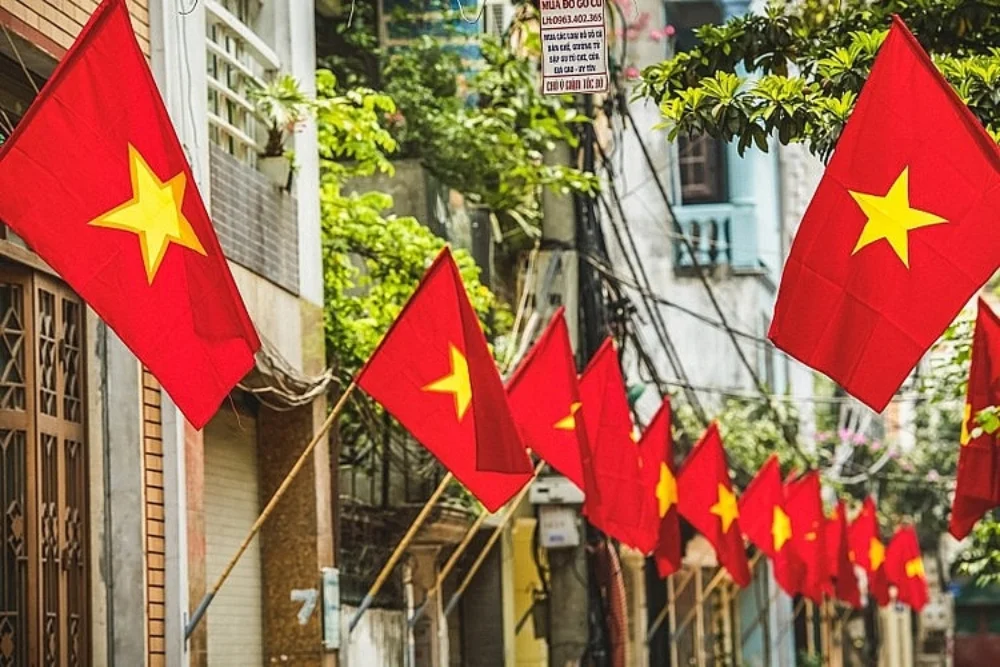
As September 2nd approaches, red flags appear everywhere, not just on big buildings, but in every neighbourhood and alley. For Vietnamese people, hanging a flag isn’t a chore; it’s a quiet act of pride. That red field is like a history book in a single symbol, standing for life, energy and an unbreakable spirit. The gold star’s five points each represent a group in society, showing that the nation moves forward as one united team. When you see a family hanging their flag, you’re seeing them connect their household to their country, and their past to their future.
Who Is “Uncle Ho”? Meet President Ho Chi Minh
Quick answer: “Uncle Ho” (Bác Hồ) is the affectionate name for President Hồ Chí Minh, the founding father of modern Vietnam. “Bác” means a respected uncle, a warm, familial term that reflects how close he remains to people’s hearts. He read the Declaration of Independence in 1945.
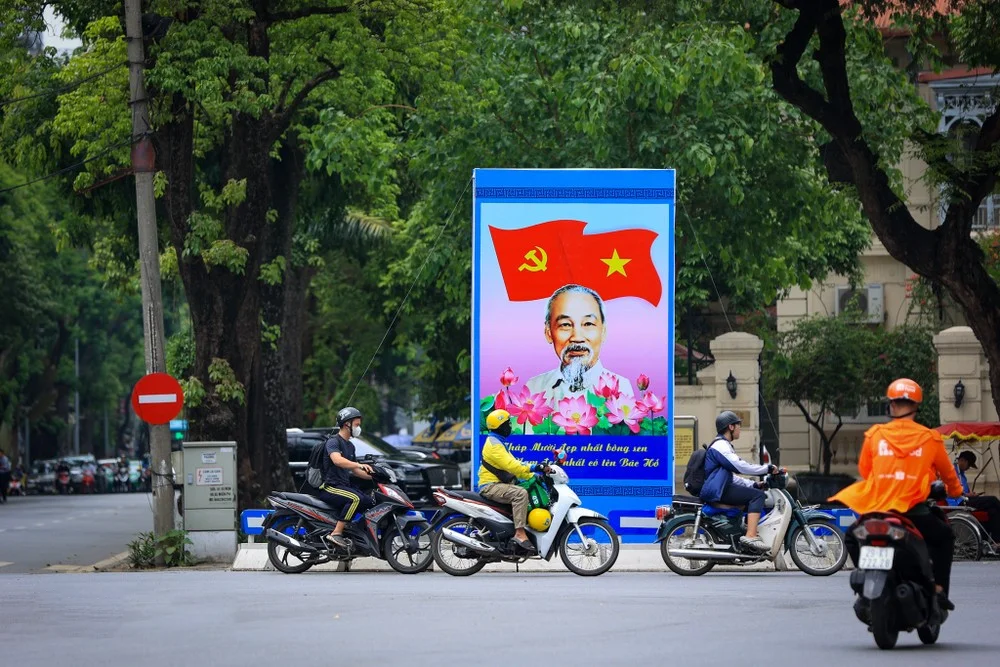
Among all the red, you’ll keep seeing one face, an older man with a gentle expression, kind eyes and a famous white beard. That’s President Hồ Chí Minh, though Vietnamese people almost never use his full name. We call him “Bác Hồ”, “Bác” being the word for your father’s older brother, a name that makes him feel less like a distant leader and more like family. He spent some 30 years travelling the world, working all kinds of jobs, in his search for a way to win independence for Vietnam. People also cherish the stories of his simple life, sandals made from old car tyres, a small wooden house instead of a grand palace. When you see his picture, you’re looking at a symbol of hope and resilience for the whole country.
Is September 2nd Like America’s 4th of July?
Quick answer: Yes and no. Both celebrate a declaration of independence, and Hồ Chí Minh even quoted the American Declaration in 1945. But while America began building after 1776, Vietnam’s 1945 declaration was only the start of a 30-year struggle that ended with Reunification Day in 1975.
It’s a great question many American visitors ask, and the answer is yes… and no. The “yes”: both holidays mark the day a nation declared, “We govern ourselves now.” There’s even a direct link, Hồ Chí Minh opened Vietnam’s 1945 declaration by quoting the American one. The “no”: for the United States, 1776 began the work of building a country. For Vietnam, 1945 was just the beginning, the nation fought for 30 more years to secure that freedom, a journey that led all the way to Reunification Day on April 30th.
Why Does September 2nd Matter Beyond Vietnam?
Quick answer: Vietnam’s 1945 declaration came amid a global wave of decolonisation, the same year the United Nations was founded. As one of the first Asian colonies to declare independence after WWII, Vietnam became an inspiration for liberation movements across Asia and Africa.
Here’s a layer many visitors don’t realise: September 2nd isn’t only a Vietnamese story. The declaration landed at a pivotal moment in world history, World War II had just ended, the United Nations was being born, and colonised peoples everywhere were beginning to demand self-rule. By grounding Vietnam’s claim in the American and French ideals of liberty, Hồ Chí Minh forced an uncomfortable question onto the world stage: either those principles were universal, or they were never really principles at all. Vietnam’s long, ultimately successful struggle to expel a colonial power became a model that echoed through independence movements across Asia and Africa for decades. Understanding this is part of what makes witnessing National Day so resonant for foreign visitors.
What Does the National Motto “Độc Lập, Tự Do, Hạnh Phúc” Mean?
Quick answer: “Độc Lập, Tự Do, Hạnh Phúc” means “Independence, Freedom, Happiness.” Born with the 1945 declaration, it’s Vietnam’s national motto and still appears at the top of every official document in the country today, a living link to September 2nd.
If you ever fill out a form in Vietnam, look at the very top: you’ll likely see the words “Độc Lập, Tự Do, Hạnh Phúc.” This three-word motto emerged with the founding of the republic in 1945 and has appeared beneath the country’s name on official paperwork ever since. It distils the whole meaning of National Day into three ideas, and “Happiness,” echoing the “pursuit of Happiness” Hồ Chí Minh quoted that day, is a telling choice for a national creed. Spotting it on a document is a small, everyday reminder that September 2nd isn’t just history; it’s woven into the fabric of modern Vietnamese life.
Where Did It All Happen? About Ba Đình Square
Quick answer: Ba Đình Square in Hanoi is where the declaration was read, and it remains Vietnam’s most important ceremonial space. It hosts the daily flag-raising and flag-lowering ceremonies and the grandest National Day parades. The Ho Chi Minh Mausoleum stands on one side.
The square itself has a story. Before 1945 this was an open area beside the French Governor-General’s palace. After the August Revolution, it was renamed Ba Đình to honour a 19th-century uprising against the French in Thanh Hóa province, so the very name carries the spirit of resistance. Today it’s the nation’s most reverential public space, anchored by the Ho Chi Minh Mausoleum. A daily flag-raising ceremony takes place each morning (around 6:00 AM in summer), performed by 34 honour guards representing the 34 original members of the army’s predecessor, with the flag hoisted up a 29-metre pole; a flag-lowering ceremony follows at 9:00 PM. If you’re in Hanoi, catching one of these ceremonies is one of the most moving ways to connect with the meaning of September 2nd, any time of year. (In Saigon, the equivalent stop is Independence Palace, where the war finally ended in 1975.)
What Is the Atmosphere Like on National Day?
Quick answer: Festive and friendly. Streets fill with happy crowds and patriotic songs, cities are decorated in flags, and there are concerts, food festivals and fireworks. You’ll also see lots of police, not a worry, just a sign the celebration is safe and well-organised.
Beyond the solemn history, National Day is genuinely fun. The streets fill with happy people, patriotic songs play everywhere, and the whole thing feels like a giant, friendly street party that everyone’s invited to. You’ll notice two things in abundance: big crowds and plenty of police. Don’t be nervous, the crowds are just families enjoying themselves, and the police are there to keep things running smoothly. As in any big gathering, just keep an eye on your belongings: wear your backpack on your chest, keep your phone and wallet in front pockets, and leave valuables at the hotel.
Today, this patriotism is expressed in wonderfully modern ways, too. Vietnam’s youth flood TikTok, Instagram and Facebook with flag-themed outfits, small waving flags and check-ins at historical landmarks, even engaging with history through AR and AI exhibitions at museums. Old and new pride, side by side.
How Can Visitors Enjoy September 2nd?
Quick answer: Dive in. Watch the morning parade and flag-raising, visit historical sites like Independence Palace (in Saigon) or Ba Đình Square (in Hanoi), soak up the street atmosphere by day, and find a riverside or lakeside spot for the evening fireworks.
If you love feeling a country’s spirit, this is a front-row seat. A simple plan for the day:
- In Ho Chi Minh City: start at the Independence Palace for the history, explore the hidden alleys and stories of the city, then head to Nguyễn Huệ Walking Street for the buzz. In the evening, cross the river to the Thủ Thiêm side for a stunning view of the fireworks over the skyline.
- In Hanoi: catch the morning parade near Ba Đình (streets like Kim Mã are good vantage points), relax at the peaceful Temple of Literature and Hoàn Kiếm Lake in the afternoon, then watch the fireworks by West Lake in the evening.
For the exact parade schedule, fireworks locations and road closures each year, see our companion guide to celebrating National Day.
Want to feel Saigon’s history and hidden corners with a local? Explore “Saigon’s Untold Stories” »
Is National Day a Good Time to Visit Vietnam?
Quick answer: It depends on your style. If you want a quiet beach escape, this busy holiday week isn’t ideal, domestic travel surges and prices rise. But if you love being where the energy is, it’s an unforgettable time to feel the country’s spirit firsthand, especially in the big cities.
Here’s the honest take. National Day is one of Vietnam’s biggest holidays, so expect a nationwide travel rush: flights, hotels and tours get pricey and book out fast, and government offices and banks close (though malls, restaurants and attractions stay open and buzzing). A local pro-tip: rather than joining the exodus to beaches and mountains, consider a city “staycation”, Hanoi and Ho Chi Minh City can feel a little less congested as residents leave town, letting you enjoy the festive atmosphere with fewer crowds. But if you’re the kind of traveller who thinks a little happy chaos is part of the adventure, you absolutely should be here.
FAQ
What does 2/9 mean in Vietnam? “2/9” is how Vietnamese people write September 2nd, National Day (Quốc Khánh). It marks the 1945 declaration of independence by Hồ Chí Minh in Hanoi, celebrated nationwide with parades, flags, concerts and fireworks.
Is September 2nd a public holiday in Vietnam? Yes. National Day is one of Vietnam’s official public holidays, and is usually combined with an adjacent day to create a long weekend. Government offices and banks close, while malls, restaurants and tourist attractions stay open.
Why do Vietnamese people call Ho Chi Minh “Uncle Ho”? “Bác Hồ” uses “Bác,” the respectful Vietnamese word for an older uncle. The affectionate term reflects how close President Hồ Chí Minh remains to people’s hearts, more like a beloved family elder than a distant historical leader.
Where can I watch the National Day fireworks? In Ho Chi Minh City, the Thủ Thiêm side of the river offers great skyline views; in Hanoi, West Lake and Hoàn Kiếm Lake are popular spots. Exact locations are announced each year, arrive early, as they get very crowded.
Should tourists avoid Vietnam on National Day? Not at all, but plan ahead. Domestic travel surges, so book transport and hotels early and expect higher prices. If you enjoy festive energy and cultural atmosphere, it’s a memorable time to visit, especially in the big cities.
What do the words at the top of Vietnamese documents mean? They read “Độc Lập, Tự Do, Hạnh Phúc”, “Independence, Freedom, Happiness”, Vietnam’s national motto, which dates from the 1945 founding of the republic. It appears on official paperwork nationwide, a daily echo of the September 2nd declaration.