


When travellers search for the best beaches Vietnam has to offer, the country is often overshadowed by Thailand, Indonesia and the Philippines. Yet Vietnam stretches along more than 3,200 km of coastline, crossing different seas, climate zones and ecosystems. Its beaches can be confusing not because they lack beauty, but because conditions vary dramatically by region, season and how each stretch of coast is managed. This guide explains how Vietnam’s coastline really works, from weather patterns and regional differences to resort-managed beaches, so you can choose a destination that suits your travel style rather than simply following a generic “best beaches” list. Get the timing and location right, and you’ll discover a coastline every bit as rewarding as Vietnam’s better-known Southeast Asian neighbours.
Why Choosing the Best Beaches in Vietnam Can Be Difficult
Quick answer: Because they’re highly uneven and seasonal. Vietnam’s 3,200 km coastline spans different climate zones, so when one region has perfect beach weather, another may be in its rainy or rough season. Beach quality also depends heavily on how a stretch is managed, with resort-controlled beaches typically much cleaner than public areas. Timing and location matter more than a simple “best” list.
The single most important thing to understand is that there’s no universal “beach season” in Vietnam. The country is so long that its regions have different, sometimes opposite, weather patterns: when the south is dry and sunny, the centre may be stormy, and vice versa. This is why a generic “top 10 beaches” list can be misleading, the right beach depends entirely on when you’re travelling.

The second key factor is management. Beach quality in Vietnam is closely tied to how a stretch of coast is maintained. Resort-managed beachfronts are typically cleaned daily and access-controlled, making them noticeably cleaner and more pleasant than public areas closer to town centres. Understanding these two factors, season and management, is the key to choosing well.
Best Time to Visit Beaches in Vietnam by Region
Quick answer: It depends on the region. Southern beaches (Phu Quoc, Con Dao, the coast near Saigon) are best in the dry season, roughly November to April. Central beaches (Da Nang, Nha Trang, Hoi An) are generally best from around March to August. Because the regions differ, there’s almost always a good beach somewhere in Vietnam, whatever the month.
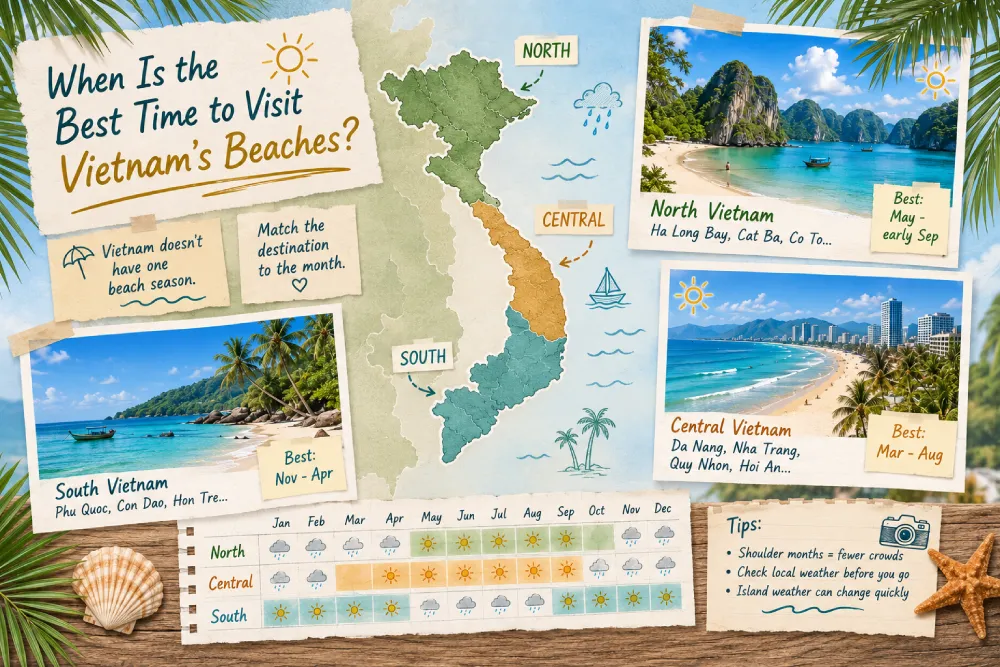
Timing is everything with Vietnamese beaches, and it varies by region:
- Southern Vietnam (Phu Quoc, Con Dao, Vung Tau and the coast near Saigon): the dry season runs roughly November to April, with calm seas, decent water clarity and reliable sunshine. This is peak beach time in the south.
- Central Vietnam (Da Nang, Nha Trang, Hoi An): generally best from around March to August, before the wetter, stormier months later in the year.
Because the south and centre peak at different times, Vietnam almost always has a good beach somewhere, which is great news for flexible travellers. The trick is simply to match your destination to the season rather than assuming the whole country shares one climate.
Best Beach Destinations in Vietnam for Different Travel Styles
Quick answer: Top choices include Phu Quoc (the south’s main beach island, with resort-lined Long Beach), Con Dao (remote, protected and pristine), Nha Trang (a lively beach city with great offshore islands), Da Nang (a modern beach city near Hoi An), and the resort beaches near major cities. Each suits a different kind of trip.
While the “best” beach depends on your timing and style, a few destinations consistently stand out:
- Phu Quoc. The south’s flagship beach island, with the resort-lined Long Beach on its west coast. Resort-managed beachfronts here are well maintained, though the island has developed rapidly, so choosing your area matters.
- Con Dao. A remote, protected archipelago with some of the cleanest water and most pristine, undeveloped beaches in the country, ideal for nature lovers willing to fly.
- Nha Trang. A lively beach city whose main draw lies offshore, where nearby islands offer clearer water and better snorkelling than the busy central shoreline.
- Da Nang. A modern, easy beach city with long sandy stretches, perfectly placed near Hoi An and central Vietnam’s highlights.
- Resort beaches near the big cities. Convenient escapes near Hanoi and Saigon, best for quick weekends rather than postcard perfection.
Phu Quoc vs Con Dao: Which Vietnam Beach Destination Is Better?
Quick answer: Phu Quoc is Vietnam’s largest island and main beach-resort destination, with long sandy beaches, resorts, and easy flights, ideal for a comfortable beach holiday. Con Dao is a remote, protected archipelago with pristine, undeveloped beaches and some of the clearest water in Vietnam, ideal for nature, diving and seclusion. Both are in the south but offer very different experiences.
Two southern islands stand out as Vietnam’s premier beach destinations, each suiting a different kind of traveller:
- Phu Quoc. Vietnam’s largest island, off the southwest coast, has become the country’s flagship beach-resort destination. Its west coast, especially the famous Long Beach, is lined with resorts and offers spectacular sunsets, while the south has quieter, clearer-watered beaches. With direct flights, a full range of accommodation, and plenty of activities, it’s the easiest choice for a comfortable, all-round beach holiday, though rapid development means choosing your area carefully.
- Con Dao. This remote archipelago, reached by a short flight, is the opposite of Phu Quoc’s bustle. Much of it is protected national park, which has preserved some of the cleanest water and most pristine, undeveloped beaches in all of Vietnam. With excellent diving, sea turtles, and a serene, reflective atmosphere, it rewards travellers seeking nature and seclusion over resorts and nightlife.
Choosing between them comes down to what you want: Phu Quoc for convenience and comfort, Con Dao for unspoiled, wild beauty.
Best Beaches in Central Vietnam: Da Nang, Nha Trang and Beyond
Quick answer: Central Vietnam holds the country’s most famous beach belt. Da Nang offers a modern beach city with long sandy shores, ideal for combining with nearby Hoi An and Hue. Nha Trang is a lively beach city whose offshore islands offer the clearest water and best snorkelling. These central beaches are best from around March to August and suit travellers wanting beaches alongside culture.
Central Vietnam is home to the country’s classic beach destinations, perfectly placed alongside its richest cultural sites:
- Da Nang. A modern, dynamic beach city with long, sandy shores and easy infrastructure. Its real advantage is location: it sits beside the ancient town of Hoi An and the imperial city of Hue, letting travellers pair beach time with central Vietnam’s cultural highlights in one trip.
- Nha Trang. A lively, long-established beach city known for its energy and amenities. While its main town beach is busy, the real magic lies offshore, where nearby islands offer clearer water, coral and excellent snorkelling and diving, easily reached by boat trips.
Both shine from roughly March to August, before the wetter season. For travellers who want their beach holiday balanced with history, food and culture, central Vietnam offers the best of both worlds, sand and sea within easy reach of some of the country’s most treasured destinations.
Vietnam’s Coastal Regions: North, Central and South Compared
Quick answer: Vietnam’s coast splits into three broad regions. The north (around Hanoi, the Gulf of Tonkin) has a summer beach season and dramatic island scenery like Ha Long and Cat Ba. The centre (Da Nang to Nha Trang) has Vietnam’s most famous long sandy beaches. The south (Phu Quoc, Con Dao, near Saigon) has a dry-season beach window and tropical islands.
Understanding the three coastal regions makes choosing far easier, as each has its own character and rhythm:
- The North (Gulf of Tonkin). Centred on the coast east of Hanoi, this region is defined by dramatic limestone seascapes like Ha Long Bay and Cat Ba Island rather than long sandy strands. Its beach season is summer (roughly May to early September), and it suits travellers combining beaches with iconic scenery and island-hopping.
- The Centre (Da Nang to Nha Trang). This is Vietnam’s classic beach belt, home to its most famous long, sandy beaches and beach cities. Generally best from around March to August, it offers the broadest mix of resort comfort, surf, islands and easy access to cultural hubs like Hoi An and Hue.
- The South (Phu Quoc, Con Dao, near Saigon). Tropical and island-focused, with the dry-season window (November to April) bringing the calmest seas. This region holds the country’s standout islands, from developed Phu Quoc to pristine, protected Con Dao.
Knowing which region matches your travel dates is the foundation of a great Vietnamese beach trip.
Common Mistakes to Avoid When Choosing Beaches Vietnam
Quick answer: The biggest mistakes are ignoring the season (visiting a region during its rainy or rough months), relying on generic “best beaches” lists that ignore timing, assuming all public beaches are clean, and underestimating travel times to remote islands. Check the regional season, prioritise well-managed beaches, and match the destination to how much time you have.

A few common pitfalls catch out beach-seekers in Vietnam, and they’re easy to avoid:
- Ignoring the season. Visiting a region in its wet or stormy months is the number-one mistake. Always check the regional season before booking, not just the calendar month.
- Trusting generic lists. A “top 10 beaches” article that ignores timing can send you to a beautiful beach at the worst possible time of year. Timing beats reputation.
- Assuming all beaches are clean. Public beaches near town centres can be busy and less maintained. If cleanliness matters to you, prioritise resort-managed or access-controlled stretches.
- Underestimating travel. Remote gems like Con Dao require flights and several days. Don’t try to squeeze a far-flung island into a day trip; match the destination to your available time.
Avoiding these comes down to one principle: plan around the season and the specifics, rather than a brochure image, and Vietnam’s coast will reward you.
Why Do Resorts Matter So Much for Vietnam’s Beaches?
Quick answer: Resorts play an outsized role because they control beach cleanliness and access. Private, resort-managed beachfronts are cleaned daily and tend to be far more pleasant than public beaches near town centres, which can be busier and less maintained. For the best beach experience in Vietnam, staying at or near a well-run resort often makes a bigger difference than the destination itself.
One of the least-discussed but most important aspects of Vietnam’s beaches is the outsized role resorts play in the experience. Unlike some destinations where public beaches are pristine, in Vietnam the cleanliness and feel of a beach often depend on whether it’s privately managed.
Resort-managed sections are typically cleaned daily, with controlled access that keeps them calmer and tidier, a significant upgrade over public beachfronts closer to town centres, which can be more crowded and less maintained. This means that, in practice, where you stay can matter as much as which destination you choose. For many travellers, booking a well-run beachfront resort, or at least a beach with managed access, is the single biggest factor in having a great beach experience in Vietnam.
What Can You Do at Vietnam’s Beaches?
Quick answer: Beyond swimming and sunbathing, Vietnam’s beaches offer snorkelling and diving (especially around Nha Trang’s islands, Con Dao and Phu Quoc), boat trips and island-hopping, fresh seafood feasts, water sports, and relaxing resort amenities. The north’s coast adds dramatic scenery like Ha Long Bay, while the islands offer the best underwater experiences. There’s something for every type of beach-goer.
Vietnam’s long, varied coastline offers far more than just lying on the sand. Depending on where you go, you can enjoy a wide range of activities:
- Snorkelling and diving. The clearest waters, around Nha Trang’s offshore islands, Con Dao and parts of Phu Quoc, offer coral reefs, marine life and excellent visibility, making Vietnam a surprisingly good underwater destination.
- Boat trips and island-hopping. From the limestone seascapes of Ha Long Bay in the north to the island clusters off Nha Trang and Phu Quoc, boat excursions are a highlight.
- Seafood feasts. Fresh, affordable seafood is a defining pleasure of the Vietnamese coast, best enjoyed at simple local restaurants near the water.
- Water sports and relaxation. Many beaches offer kayaking, jet-skiing and other water sports, while resort beaches provide spas, pools and all the comforts for pure relaxation.
This variety means you can tailor your beach trip to be as active or as restful as you like, from adventurous diving to lazy days by the sea.
How Do You Get to Vietnam’s Beaches?
Quick answer: Most major beach destinations are reached by domestic flights, Phu Quoc, Con Dao, Da Nang and Nha Trang all have airports, making them quick to reach from Hanoi or Ho Chi Minh City. Beaches near the big cities (like Vung Tau near Saigon, or the coast near Hanoi) are reached by road or ferry. Vietnam’s improving transport network makes the coast more accessible than ever.
Reaching Vietnam’s beaches has become increasingly easy thanks to the country’s expanding transport network. The approach depends on your destination:
- By air. The major beach destinations, Phu Quoc, Con Dao, Da Nang and Nha Trang, all have airports served by domestic flights, making them quick and convenient to reach from the main hubs of Hanoi and Ho Chi Minh City. This is the standard way to reach the famous beaches.
- By road and ferry. The beaches closest to the big cities are reached overland. From Saigon, Vung Tau is a short drive or ferry away, while the coast near Hanoi is reached by road and ferry. These make great quick escapes without needing to fly.
For the islands, always check ferry and flight schedules in advance, as they affect your timing and can be influenced by weather. Whichever beach you choose, planning your transport ahead, especially in peak season, ensures a smooth, stress-free journey to the coast.
How Do You Choose the Right Beach in Vietnam?
Quick answer: Work backwards from three things: your travel dates (which determine the best region by season), your style (lively city beach, secluded nature, or resort relaxation), and your access point (north or south). Then pick a destination and prioritise well-managed beaches. Matching season, style and location beats chasing a generic “best beaches” list.
Rather than chasing a one-size-fits-all list, choose your beach by working through three questions:
- When are you travelling? This determines the region. Travelling November to April? Look south (Phu Quoc, Con Dao, the coast near Saigon). Travelling March to August? The centre (Da Nang, Nha Trang, Hoi An) shines.
- What’s your style? Want a lively beach city? Try Nha Trang or Da Nang. Crave secluded, pristine nature? Con Dao or quieter islands. Prefer to relax at a resort? Phu Quoc or the resort beaches near the cities.
- Where are you based? If you’re near the capital, see our guide to the beaches near Hanoi. If you’re in the south, explore the best beaches near Ho Chi Minh City.
Match these three factors, lean towards well-managed beaches, and you’ll choose a destination that fits how you actually travel.
What Should You Know Before Visiting a Vietnamese Beach?
Quick answer: Check the regional season to avoid rough seas and rain, and be aware that conditions vary. Watch for strong currents and obey any safety flags, as some beaches have undertows. Protect yourself from the strong tropical sun. Book accommodation ahead in peak season, and for the cleanest, calmest experience, favour resort-managed or access-controlled beaches over crowded public ones.
A little preparation makes any Vietnamese beach trip safer and more enjoyable. Keep these practical points in mind:
- Mind the season. The single most important factor. Check the regional weather window before you book, since visiting during a region’s wet or stormy months can mean rough water and grey skies.
- Respect the water. Some beaches have strong currents or undertows. Pay attention to any warning flags, swim in designated areas, and take extra care in the rainy season when seas can be rougher.
- Sun protection. The tropical sun is intense. Use sunscreen, a hat and shade, especially in the middle of the day.
- Book ahead. In peak season and on Vietnamese holidays, popular beaches and resorts fill up and prices rise, so reserve accommodation and transport in advance.
- Choose well-managed beaches. For the cleanest, calmest experience, favour resort-managed or access-controlled stretches over busier public beaches.
With these basics covered, you’re set to enjoy Vietnam’s coast safely and to the fullest, whatever corner of the country you choose.
Choosing Your Perfect Vietnamese Beach
Vietnam’s beaches aren’t worse than its Southeast Asian neighbours, they’re just more varied and seasonal, which rewards travellers who understand the system. Once you grasp that the coast works by region and season, and that resort management shapes the experience, the confusion clears and the choices become exciting. Whether you want the pristine seclusion of Con Dao, the resort comfort of Phu Quoc, the energy of Nha Trang, or a quick weekend escape from the city, there’s a perfect Vietnamese beach waiting, you just need to match it to your timing and style. Get those two things right, and Vietnam’s long, beautiful coastline will reveal itself as one of Southeast Asia’s most underrated beach destinations.
Before you head for the coast, get to know the real Saigon, its backstreets, food and stories, the local way. Explore the city by Vespa on the Saigon Untold Stories »
Frequently Asked Questions
What are the best beaches in Vietnam? Top destinations include Phu Quoc (the south’s main resort island), Con Dao (remote and pristine), Nha Trang (a lively beach city with great offshore islands), and Da Nang (a modern beach city near Hoi An). The “best” depends on your travel dates and style, since Vietnam’s beaches are highly seasonal and regional.
When is the best time for a beach holiday in Vietnam? It depends on the region. Southern beaches (Phu Quoc, Con Dao, near Saigon) are best in the dry season, roughly November to April. Central beaches (Da Nang, Nha Trang, Hoi An) are generally best from around March to August. Because regions differ, there’s almost always a good beach somewhere in Vietnam.
Why are Vietnam’s beaches so inconsistent? Because they’re highly seasonal and management-dependent. Vietnam’s 3,200 km coastline spans different climate zones, so regions peak at different times, and beach cleanliness depends heavily on whether a stretch is resort-managed (cleaned daily) or a public area (often busier and less maintained).
Is Phu Quoc or Con Dao better? They suit different travellers. Phu Quoc is the more developed resort island, with well-maintained beachfronts and plenty of amenities, best for a comfortable resort holiday. Con Dao is remote and largely protected national park, with some of the cleanest, most pristine beaches in Vietnam, best for nature and seclusion.
Do you need to stay at a resort for a good beach in Vietnam? Not strictly, but it helps. Resort-managed beaches are cleaned daily and access-controlled, making them noticeably cleaner and calmer than many public beaches near town centres. For the best experience, staying at or near a well-managed beach often matters as much as the destination you choose.