

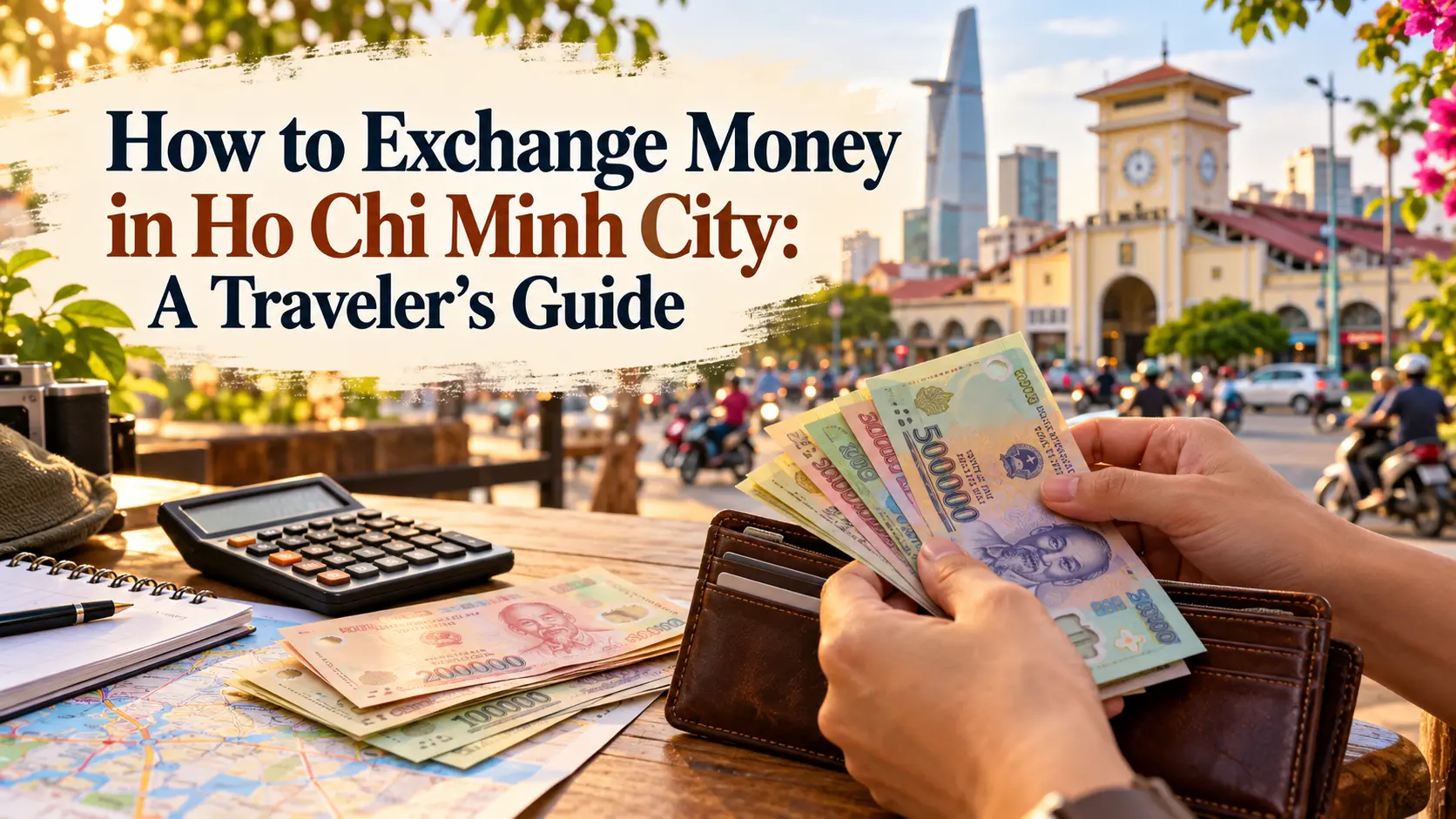
Ho Chi Minh City is Vietnam’s bustling economic hub, and whether you’re here for leisure or business, you’ll need Vietnamese Dong (VND) for most everyday transactions, and knowing where and how to exchange money makes a real difference. The gap between a good rate and a bad one adds up over a trip, and a few simple precautions keep you safe from scams and counterfeit bills. This guide covers the currency itself, the best places to exchange, how ATMs work, and the etiquette of handling cash in Saigon.
What Is the Currency in Vietnam?
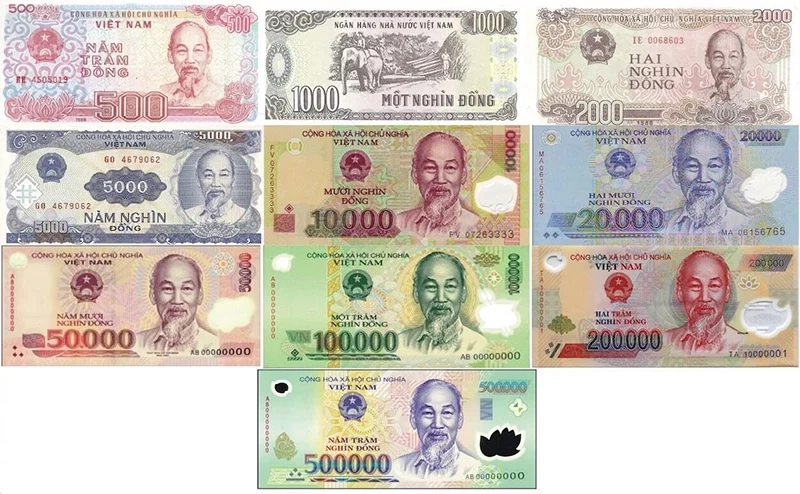
Quick answer: The official currency is the Vietnamese Dong (VND). It comes in denominations from 1,000 up to 500,000 VND, with the larger notes (10,000+) made of polymer. Locals abbreviate thousands as “k”, so 50,000 VND is “50k”, and prices often drop the currency word entirely.
Before you exchange anything, get familiar with the money. The Vietnamese Dong comes in nine denominations, from small cotton notes (1,000-5,000 VND) to larger polymer bills (10,000 up to 500,000 VND). A couple of things trip up newcomers:
- The “k” shorthand. Locals denote thousands with “k,” so a 50,000 VND price is spoken or written as “50k.” Prices frequently omit the currency word entirely.
- The 500,000 and 20,000 trap. The 500,000 VND note (the largest) and the 20,000 VND note are both bluish and easily confused, double-check before you hand one over.
- Carry small notes. Big bills can be hard to break for small purchases, so keep a mix of smaller denominations handy.
Where Are the Best Places to Exchange Money in Saigon?
Quick answer: Your main options are banks (safest, with receipts, but slower and during business hours only), licensed exchange counters (convenient, in malls and tourist areas), gold/jewellery shops near Bến Thành Market (often the best rates, used by locals, but a legal grey area), and ATMs. Reputable gold shops in District 1 tend to offer the most competitive rates.
Saigon gives you several options, each with trade-offs:
- Banks, the safest, most secure choice. Major banks like Vietcombank, BIDV and Sacombank have branches citywide, give official receipts, and minimise counterfeit risk. The downsides: slower service, business hours only, and you’ll need your passport.
- Licensed exchange counters, found in malls, tourist areas and at Tân Sơn Nhất Airport. Convenient and quick, with reasonable rates. Make sure the counter is licensed (usually backed by an official bank) to avoid scams.
- Gold and jewellery shops, the local favourite, especially the shops near Bến Thành Market in District 1, which often offer the best rates with no commission and quick service. Note that they operate in a legal grey area, so count your money carefully and walk away if anything feels off.
- ATMs, convenient for withdrawing VND directly (covered below).
Should You Exchange Money at the Airport?
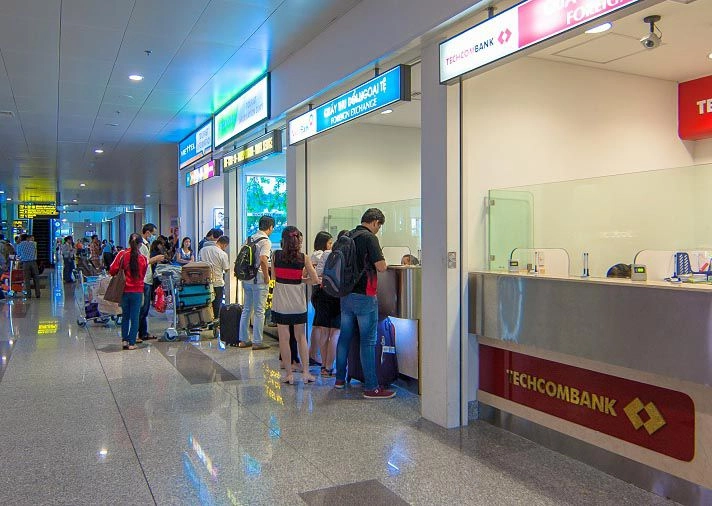
Quick answer: Only a little. Airport exchange counters are convenient but generally offer poorer rates than the city centre, so exchange just enough to cover your taxi or Grab and initial needs, then change the bulk of your money at a better rate in District 1. Better yet, pay for your airport transfer by card via Grab and skip airport exchange entirely.
This is one of the most useful money tips for Saigon. Like most airports worldwide, the currency counters at Tân Sơn Nhất tend to give less favourable rates than what you’ll find in the city. The smart move is to either exchange only a small amount to cover immediate costs and change the rest downtown, or skip airport exchange altogether, a Grab from the airport can be paid by card, getting you to District 1 cashless, where you can exchange at a far better rate. There’s no need to exchange VND before you even arrive in Vietnam.
How Do ATMs Work in Vietnam?
Quick answer: ATMs are widely available in cities and dispense VND directly from foreign Visa/Mastercard. Expect foreign-transaction fees (often around 100,000 VND per withdrawal) and low per-transaction limits (commonly 2-3 million VND). Always choose to be charged in Vietnamese Dong, not your home currency, for a fairer rate.
ATMs are a practical way to get cash, with a few things to know. Most Vietnamese ATMs accept Visa and Mastercard and dispense Dong directly, regardless of your home-account currency. However, foreign cards usually incur a withdrawal fee (often around 100,000 VND), and many machines cap withdrawals at 2-3 million VND per transaction, so larger sums mean repeated fees. Two tips save you money: check whether your home bank has a partner bank in Vietnam to reduce fees, and always select “charge in local currency (VND)” rather than your home currency when the machine offers, choosing your home currency triggers a poor built-in conversion rate.
How Do You Avoid Money Exchange Scams in Saigon?
Quick answer: Stick to banks, licensed counters and reputable, busy gold shops, never exchange with street vendors. Always check the current rate beforehand, do your own math on your phone’s calculator, count your money in front of the seller, and inspect notes for authenticity and damage. Walk away if anything feels off.
A little caution keeps your money safe. The key precautions:
- Avoid street vendors. Exchanging on the street often leads to scams or counterfeit bills. Stick to legitimate banks, licensed counters and established shops.
- Know the rate first. Check the current mid-market exchange rate on your phone before you exchange, so you can spot a bad deal. (Rates change daily, so always check fresh.)
- Do your own math. The agent will calculate your total on a calculator, some unscrupulous ones use rigged calculators showing a lower amount, so verify with your own phone calculator.
- Count in front of the seller. Count your Dong before leaving, and inspect notes for authenticity; reject damaged or excessively worn bills, as vendors may refuse them later.
- Choose busy exchanges. A crowded shop is generally a reputable one.
How Much Cash Should You Carry in Saigon?
Quick answer: Cash is still essential for daily life in Saigon, street food, markets, taxis, small shops and tips all run on Dong. Cards work at upscale hotels, malls and restaurants, but for an authentic local experience, keep enough cash on hand and always pay in VND rather than US dollars for the fairest value.
While cards are accepted at larger hotels, malls and high-end restaurants, cash remains king for everyday Saigon life, street food, markets, local eateries, taxis and tipping all expect Dong. Some upscale places accept US dollars, but paying in VND gives wider acceptance and a fairer price, since individual vendors often apply poor dollar rates. Pro tip: Carry enough cash for your day’s plans.
Once your wallet’s sorted, the best of Saigon is out on the streets. Explore the hidden corners and secrets of Saigon with us on our Saigon Untold Stories.
Should You Use Cards or Cash in Ho Chi Minh City?
Quick answer: Use both. Cards (Visa, Mastercard) work at hotels, malls, larger restaurants and tourist-facing shops, while cash is essential for street food, markets, taxis, small shops and tipping. Carry a mix: a card for big or formal purchases, and enough Vietnamese Dong for everyday spending. Always pay in VND, not foreign currency.
Knowing when to reach for cash versus a card saves hassle. Cards are increasingly accepted at hotels, shopping malls, mid-to-upscale restaurants and established tourist shops, and contactless payment is spreading fast in the city. However, the heart of Saigon life, street food stalls, traditional markets, small family eateries, taxis and tipping, still runs almost entirely on cash. The practical approach is to keep a card for larger or formal transactions and always carry enough Dong in small and mid denominations for daily spending. Some venues accept US dollars, but they often apply poor rates, so paying in Vietnamese Dong is consistently the better value and the more widely accepted choice.
Frequently Asked Questions
Should I exchange money before arriving in Vietnam? No need. Rates abroad are usually worse, and you can pay for a Grab from the airport by card to reach the city cashless. Exchange only a small amount at the airport if needed, then change the bulk in District 1 at a better rate.
Is it better to exchange money or use an ATM in Vietnam? Both work. Exchanging cash at a good gold shop often gives the best rate, while ATMs are convenient but charge foreign-transaction fees (around 100,000 VND) and cap withdrawals at 2-3 million VND. If using an ATM, always choose to be charged in Vietnamese Dong, not your home currency.
Can I use US dollars in Vietnam? Some upscale hotels, restaurants and shops accept US dollars, but it’s not universal, and vendors often apply poor exchange rates. Paying in Vietnamese Dong gives wider acceptance and fairer prices, so it’s best to exchange your money and use VND for everyday transactions.
How do I avoid money exchange scams in Saigon? Avoid street vendors entirely, and use banks, licensed counters or busy, reputable gold shops. Check the current rate beforehand, verify the total with your own phone calculator, count your money in front of the seller, and inspect notes for authenticity. Walk away if anything feels wrong.
Do I need cash in Ho Chi Minh City? Yes. Cash is essential for street food, markets, taxis, small shops and tipping, even though cards work at upscale venues. Carry enough Vietnamese Dong for your daily plans, and pay in VND rather than US dollars for the fairest value.