

If you’re searching for the best eSIM Vietnam, you’re probably asking the same questions most travellers do: Can I even use an eSIM here? Should I buy before I land? Is it cheaper than a local SIM? From a local perspective, the answer isn’t just about price. It’s about coverage, reliability in rural areas like Ha Giang, and what happens when you run out of data with no WiFi in sight. This guide breaks it all down honestly, no hype, just what actually works in Vietnam.
Can You Use an eSIM Vietnam?
Quick answer: Yes, you can absolutely use an eSIM in Vietnam. Vietnam’s three major networks, Viettel, Vinaphone and Mobifone, all support eSIM technology, and tourists typically access them through international eSIM providers like Airalo, Saily and Holafly. As long as your phone is eSIM-compatible (most models from 2020 onward are), you can be connected within minutes of landing.
The short answer is yes, eSIMs work well in Vietnam. The country’s three major mobile networks, Viettel (the largest, with the widest nationwide coverage), Vinaphone and Mobifone, all support eSIM technology. As a tourist, you generally don’t sign up with these networks directly. Instead, you access them through international eSIM providers such as Airalo, Saily, Holafly and others, which partner with the local networks.

The key thing to understand is that the question isn’t really whether an eSIM works, but which network your eSIM connects to behind the scenes. This matters enormously once you leave the big cities. For a city-focused trip to Hanoi, Ho Chi Minh City or Da Nang, almost any provider works fine. For anything more adventurous, coverage becomes the deciding factor. First, make sure your phone actually supports eSIM, most models from around 2020 onward do, but it’s worth checking before you rely on it.
Is an eSIM Better Than a Local SIM Card in Vietnam?
Quick answer: It depends on your priorities. An eSIM wins on convenience: you set it up before you arrive, skip the airport queues, and don’t handle a physical card. A local SIM (like Viettel) often wins on pure cost and can include a local phone number and strong rural coverage. For most short-trip travellers who value ease, an eSIM is the better choice.
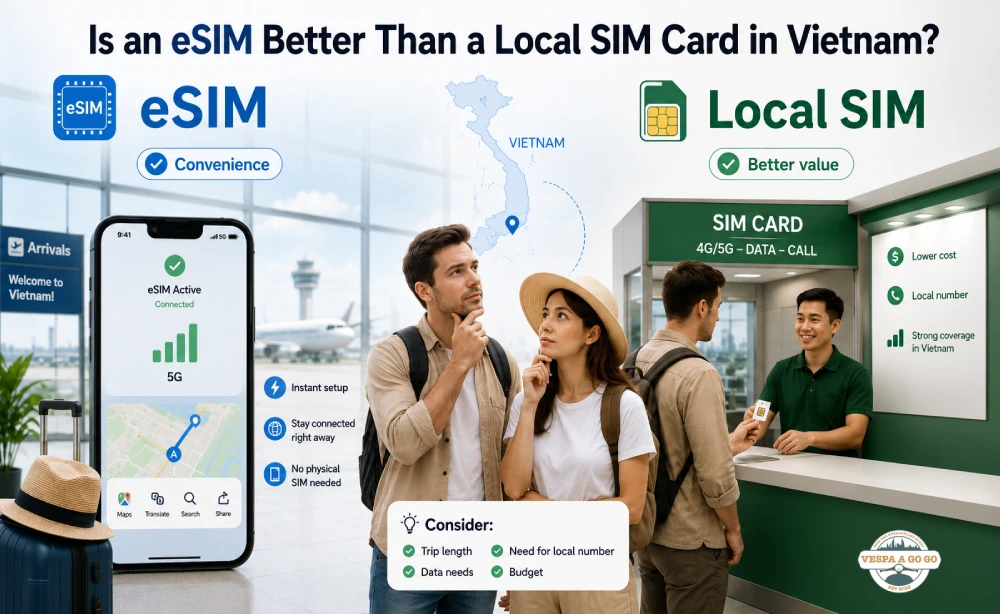
This is the real question, and the honest answer is that it’s a trade-off between convenience and cost:
- Choose an eSIM if you value convenience. You buy and install it online before your trip, so you land already connected, with no airport queues, no ID paperwork, and no fiddling with tiny cards. It’s the smoother, more modern option, ideal for short city-focused trips.
- Choose a local SIM if you value cost and rural coverage. A physical local SIM, especially from Viettel, is often cheaper per gigabyte, can come with a local phone number, and connects you directly to the strongest network for remote areas. The downside is buying it in person on arrival.
For most travellers on a typical trip who prioritise a stress-free arrival, the eSIM is the better pick. Those heading deep into rural or mountainous regions, or staying long-term, may prefer the value and coverage of a local Viettel SIM. Note that most international eSIMs are data-only and don’t come with a phone number.
Which eSIM has the Best Coverage in Vietnam?
Quick answer: Coverage depends on the local network your eSIM uses, not the brand name. Viettel has by far the best nationwide coverage, especially in rural and mountainous areas like Ha Giang and Sapa. If your trip goes beyond the main cities, choose an eSIM that clearly runs on Viettel. For city-only trips, any major network works well.
This is the most important, and most overlooked, part of choosing an eSIM for Vietnam. What really matters isn’t the provider’s brand name, but which local network your plan actually uses. And in Vietnam, the networks are not equal when you leave the cities.
Viettel has by far the widest and most reliable coverage nationwide, particularly in the rural and mountainous regions where travellers most often lose signal, places like the Ha Giang loop, Sapa, and remote national parks. Vinaphone and Mobifone are perfectly good in cities and many populated areas, but can be patchier in the far north or deep countryside. The practical rule is simple: if your itinerary is city-focused (Hanoi, Ho Chi Minh City, Da Nang), almost any provider is fine. But if you’re doing a proper north-to-south route or heading into the mountains, look for an eSIM that clearly states it runs on Viettel, and check the host network on the plan page before buying, since it can vary.
How Do You Choose the Right eSIM Plan?
Quick answer: Choose based on three things: the local network (Viettel for rural coverage), your data needs (light browsing needs little; streaming and remote work need a lot), and your trip length (plans have fixed validity periods). Match these to your travel style rather than just picking the cheapest plan, and check whether hotspot/tethering is allowed if you need it.
Rather than just grabbing the cheapest option, choose your eSIM plan by matching it to how you’ll actually travel. Consider these factors:
- Network coverage. As covered above, this is the top priority for anyone going beyond the cities. Verify the plan uses Viettel if rural coverage matters.
- Your data needs. Light use (maps, messaging, ride-hailing, social media) needs relatively little data. Streaming video, video calls or remote work will burn through it fast, so estimate honestly based on your habits.
- Trip duration. eSIM plans come with fixed validity periods, from a few days to a month or more. Pick one that comfortably covers your stay.
- Hotspot and extras. If you need to tether your laptop or other devices, check the plan allows hotspotting, as some limit or cap it. Some plans also bundle extra features.
Matching these to your travel style will get you a far better experience than simply chasing the lowest price, which is where many guides fall short.
How Do You Set Up and Activate an eSIM Vietnam?
Quick answer: Setup is quick and done online. Buy your plan from a provider’s app or website, then you’ll receive a QR code. Scan it to install the eSIM (ideally while you still have WiFi or data at home before your trip), then activate it on arrival in Vietnam by enabling the eSIM line and data roaming for it. The whole process usually takes just a few minutes.
One of the biggest advantages of an eSIM is how simple it is to set up, no shops, no queues. The general process is:
- Buy online. Choose your provider and plan through their app or website and complete the purchase. You’ll be sent a QR code and instructions.
- Install before you fly. Scan the QR code to install the eSIM onto your phone while you still have a reliable internet connection at home. This adds the eSIM as a second line without removing your home SIM.
- Activate on arrival. When you land in Vietnam, enable the eSIM line and turn on data roaming for it in your phone’s settings. Many plans activate automatically once they detect a local network.
- Troubleshoot simply. If something doesn’t connect, toggling airplane mode on and off often forces a network refresh.
Always follow your specific provider’s instructions, as steps vary slightly by app and phone. Once connected, you’re ready to navigate, book rides and stay in touch. For the apps you’ll want alongside your data, see our guide to the best apps to use while travelling in Vietnam.
A Local’s Bottom Line on eSIMs for Vietnam
For most travellers, an eSIM is the easiest, most stress-free way to stay connected in Vietnam, letting you land already online without the airport hassle. The single most important tip, from a local perspective, is to stop obsessing over tiny price differences and instead focus on coverage: if your trip ventures beyond the big cities, prioritise an eSIM that runs on Viettel. For a pure city break, almost any reputable provider will serve you well. Get that one decision right, and you’ll stay connected smoothly whether you’re navigating Hanoi’s Old Quarter or riding the mountain roads of the far north.
Staying connected is easy once you’re here, and the best way to discover the real Saigon is with a local guide who knows every hidden corner. Explore the city on the Saigon’s Untold Stories »
Frequently Asked Questions
Can I use an eSIM in Vietnam? Yes. Vietnam’s three major networks, Viettel, Vinaphone and Mobifone, all support eSIM technology, and tourists typically access them through international providers like Airalo, Saily and Holafly. As long as your phone is eSIM-compatible (most models from 2020 onward are), you can be connected within minutes of arriving.
Which network has the best coverage in Vietnam? Viettel has by far the best nationwide coverage, especially in rural and mountainous areas like Ha Giang and Sapa. Vinaphone and Mobifone are good in cities but can be patchier in remote regions. If your trip goes beyond the main cities, choose an eSIM that clearly runs on the Viettel network.
Is an eSIM cheaper than a local SIM in Vietnam? Not always. A local physical SIM, especially from Viettel, is often cheaper per gigabyte and can include a local phone number. However, an eSIM wins on convenience, since you set it up before arrival with no queues or paperwork. For most short-trip travellers, the small extra cost is worth the ease.
Should I buy an eSIM before I arrive in Vietnam? Yes, that’s the main advantage. You can buy and install an eSIM online before your trip, then activate it the moment you land, so you’re connected immediately without hunting for a shop or waiting in an airport queue. Just install it while you still have a reliable internet connection at home.
Do eSIMs work in rural areas like Ha Giang and Sapa? They can, but coverage depends entirely on the local network your eSIM uses. In remote and mountainous areas, Viettel is the most reliable network by far. If your itinerary includes places like Ha Giang, Sapa or the Mekong Delta, choose an eSIM that clearly runs on Viettel and verify the host network before buying.